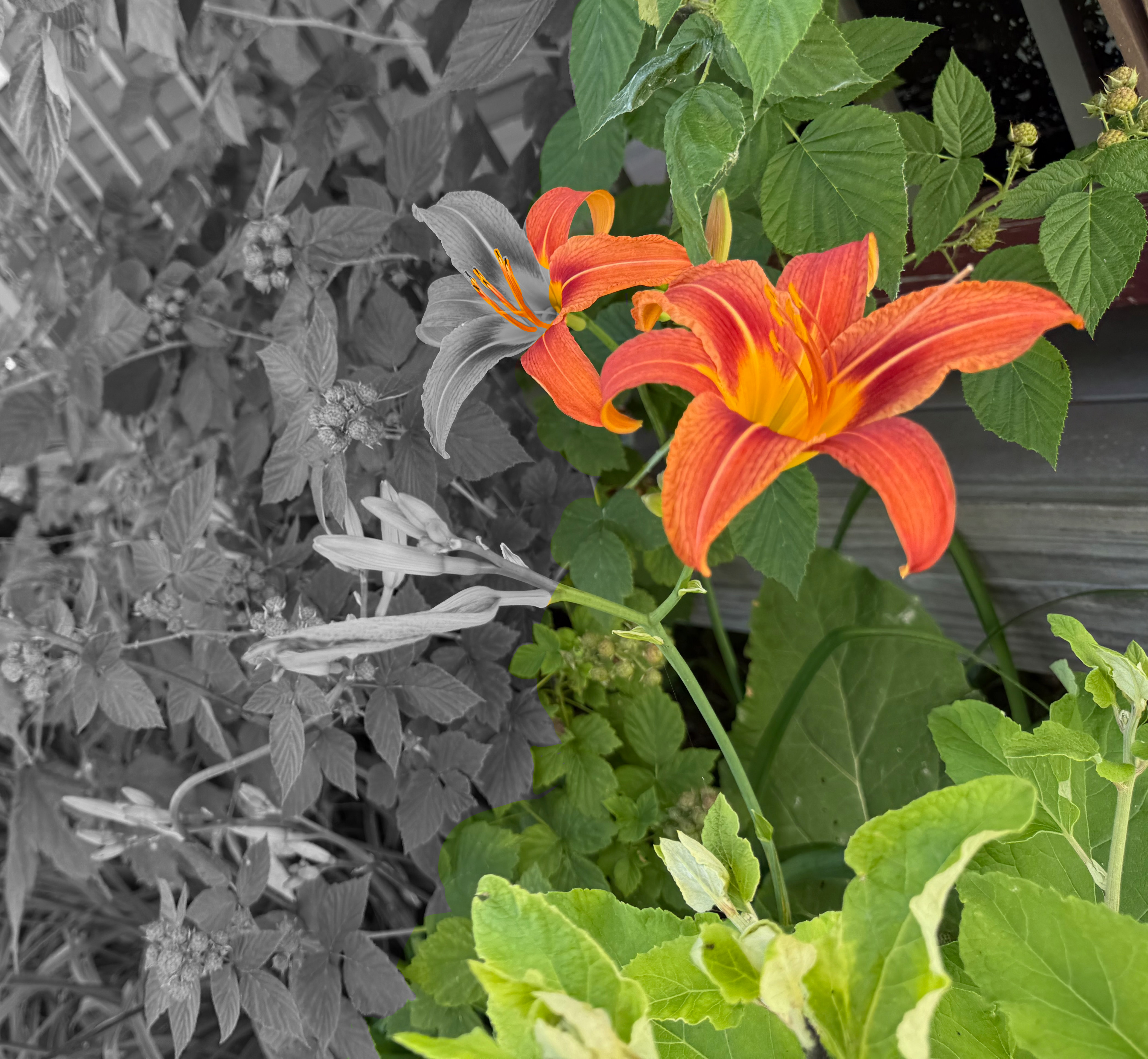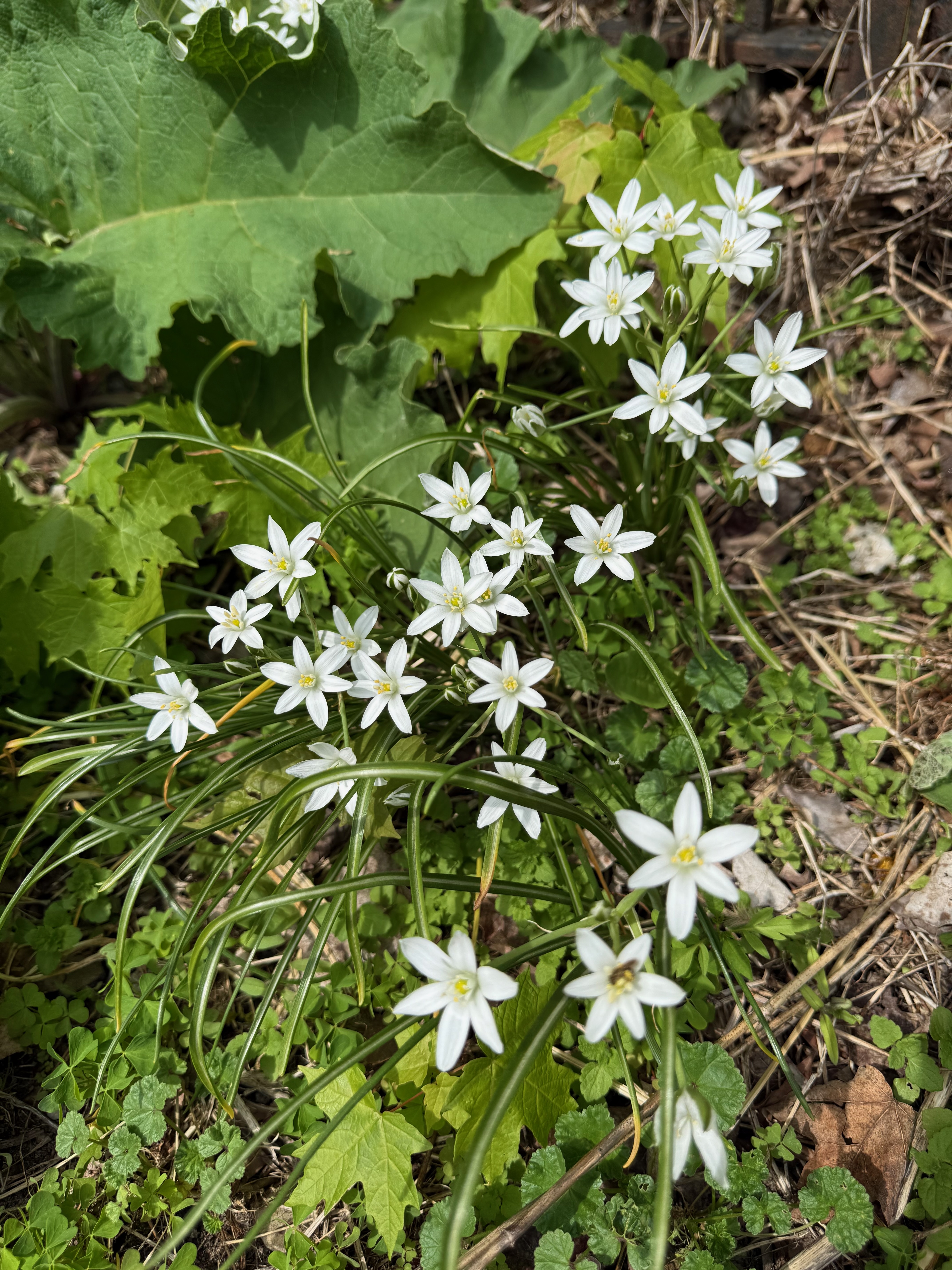
Star of Bethlehem, aka Grass Lillies, growing amidst the rhubarb and weeds in the unkempt vegetable garden, May 2026.

It’s different this time. I’ve been here before. A second-time widow now 14 years older, wiser, more prepared for the storm ahead. I knew I could fall deep into the wake of sadness.

Back when it was my first time, I thought I would die from the pain, so deep, so shattering I couldn’t imagine life going on.

I was in Yekaterinburg, Russia teaching on a Fulbright grant when I first got the news of this diagnosis. Keith hadn’t been getting better, even saying its just a lingering case of bronchitis. He promised me he’d go back to his doctor as he dropped me at the airport and we kissed goodbye.

As studious as I was, I was uneducated in the lingo of cancer, or the many euphemisms it could go by. Sitting in my hotel, and so unnerved by Keith’s ambiguous yet clearly unhopeful words he’d texted to me, I was desperate to reach back out to him.

I found a way to make a phone call over Skype by paying for a phone number. When the call went through, I could hear how surprised he was when he saw the local number but heard me talking to him from over 5000 miles away in the middle of Russia. But I had to hear his voice. I had to make sure I wasn’t overreacting.

I could hear his weakened voice muddied by exhaustion from tests he’d undergone while I had been away, unplanned but supported by my daughters. Metastatic Liver Disease, he said, though I wasn’t sure what he really said until it sunk in minutes later.

“That doesn’t sound good,” I replied.

“Nope”, he reluctantly and quietly agreed.

“Do you want me to come home?”

“Yes,” came the nearly whispered reply.

And at that I knew how serious it was. Usually the midwest stoic, Keith had always pushed through and never asked me for help when it came to his healthcare. But not this time. Now, he needed me and I was on the other side of the world.

Usually the midwest stoic, Keith had always pushed through and never asked me for help when it came to his healthcare.
But not this time.
Now, he needed me and I was on the other side of the world.

As I ended the call, quiet “I love you’s” exchanged, I felt trapped. I needed to scream, to cry, to shout. But I feared being seen as the crazy American in this industrial Russian city. I already was pretty much the ONLY Amerikanski here.

I took a different route and had the good sense to go and cry in the shower so few could hear me. But as the water poured over me in the modern white subway-tiled shower, I slid down the wall into a pool of tears and rain shower droplets, trying to cleanse myself of this deep despair.

That was the start of the first time, and the most painful, most despairing experience of my life. The only thing that kept me from ending my own was the knowledge that my own daughters needed their me, their mom. I needed to get home.

Fast forward to the present.

Here I am, now wrapping up a year into my second term as a widow. So many projects left undone. So many questions I would ask Steve as I tried to take my first steps. But the springtime came anyway. And now I stare out at the untended and unplanted vegetable garden patch where we would have tilled and replanted our tomatoes, and beans, and spinach.

Me and Steve, fishing from the shore after we’d sold the boat about a year after he was diagnosed with Stage IV lung cancer, June 2024, Big Fish Lake, Ortonville, Michigan.

It has been hard, for sure. I loved Steve dearly, my second husband, in a different kind of love than my first husband. As an older relationship, we were not hampered with career growth, or raising young children. All adults, Steve brought six children to my two. And they came with their various partners, and growing families. Together, we enjoyed a life we built that was happy, supportive, loving, playing creatively, like two overgrown kids.

When the diagnosis came, Stage IV Lung Cancer, something switched on for me. Survival mode. There were Caregiving tasks that needed to be addressed. Appointments to be made, and people to keep in the loop.

Over the next 2-1/2 years, PTSD from my earlier loss would creep in. But I managed to keep my outward crying to a minimum. We would use whatever time we were gifted to try and continue to live a happy life together, with as much or as little as was required to do that, even if it was just sharing a sweet smile, a loving embrace, and the quiet “I love you’s”.

I realized that what I feared, even more than losing Steve, was also losing this beautiful family he had brought with him. And most directly, losing Sam and his family who had become close to my own older daughter’s family, and who would visit often, despite his long distance. When I shared this with Sam, I was met with a loving reassurance that we’d always be family.

His last few weeks were both physically and emotionally challenging. Ups and downs, exhaustion, tears, laughter, and moments that could be the making of a comedy skit. That is, if it weren’t the end.

His last few weeks were both physically and emotionally challenging. Ups and downs, exhaustion, tears, laughter, and moments that could be the making of a comedy skit. That is, if it weren’t the end. So when Steve died, a sort of numbness took over that was somewhat familiar to me. It served me well enough as I got through the first months after his passing. It is a type of emotional survival mode that would carry me through the worst of it. My caregiving duties were over. Now I could sleep through the night and work on caring for myself.

Between the chaotic weather and my aching back, I’ve given myself permission not to replant the whole vegetable garden. Maybe I’ll just do potted tomatoes and herb plants on the upper deck again this year.

Now, as I looked out at all the various weeds overgrown from my second-story perch, I couldn’t make out what is really there in the untended patch. It just didn’t look like a vegetable garden anymore. On my next walk around at ground level, I made a point to check into the weedy fenced-in patch, ignored and now mocking me with the warming weather after a long cold dark winter.

To my surprise, the already overgrown rhubarb persists even now, despite a decade or more of neglect. It was first planted on other parts of the property by the original 19th Century owners of the property, and has survived constant disruptions of the land over the last 180 years.

And amidst the weeds that filled in the gaps around the rhubarb, starlike white flowers peaked through their thin green leaves that I’d never seen here before. These abundant patches of Star of Bethlehem grass lilies sparkled with hope as the season of new life and purpose unfolds before me.

To make sure I take care of myself in this new chapter, I remind myself to lean in on my toolkit for grief. It is one developed from years of practice living with hope, death and respair, a long forgotten word meant to describe finding fresh hope after despair.

And so, it is is with respair in mind, that I share this toolkit for navigating a journey through grief:

  • Practice compassion. For yourself, as well as others. You never know if the one you’re speaking to is going through a difficult time, as well.
  • Breath. Never forget to. When I was learning to scuba dive, the instructor knew that when the beginner diver goes under water – complete with all the breathing gear – their instinct is to hold their breath. We can’t keep holding our breath, even when we may feel like we’re drowning in grief. Just… breath.
  • Feel all the feels. There is no timeline on grieving. There is no schedule for it. Something triggers a memory – a song, a bird, a word – and the wave overtakes you. And you find yourself in a puddle of tears. Let it out and after the tears, a lightness may take over.
  • No one can take away your grief. But having a friend or companion who is a good listener can definitely help. And if that’s not doable, for whatever reason, find a compatible therapist, an objective listener trained for just such purposes.
  • Scream and cry if you must. Do it safely so that you can still wake up to another day.
  • Read a good book. Even when it makes you cry. Joan Didion’s “Year of Magical Thinking” brought me all the feels. I needed to know I wasn’t alone in these experiences.
  • Make something new. There’s a certain spark that comes with a new adventure, no matter how small.
  • Make something familiar. There’s comfort that comes with revisiting the familiar tasks that become your meditation.
  • Write it down. Share your story in the written word, as much or as little as you need to. Writing it down is like casting it off into the stars.
  • Take a walk, if you can. Especially in nature. This afternoon, I could admire the Star of Bethlehem grass lilies that found ways to create a sparkling view, even in the midst of my untended and unplanted vegetable garden.
  • Cry, dance, and sing when the music plays.
  • Grant yourself grace. Especially on the days when it seems too much.
  • Practice smiling again. It may feel awkward at times, but eventually it will become natural again.
  • Give yourself permission. To cry, to love, to be happy…
  • Talk to him/her. They’re still listening.
  • And as time passes, be open to the growing possibilities of future happiness in life.
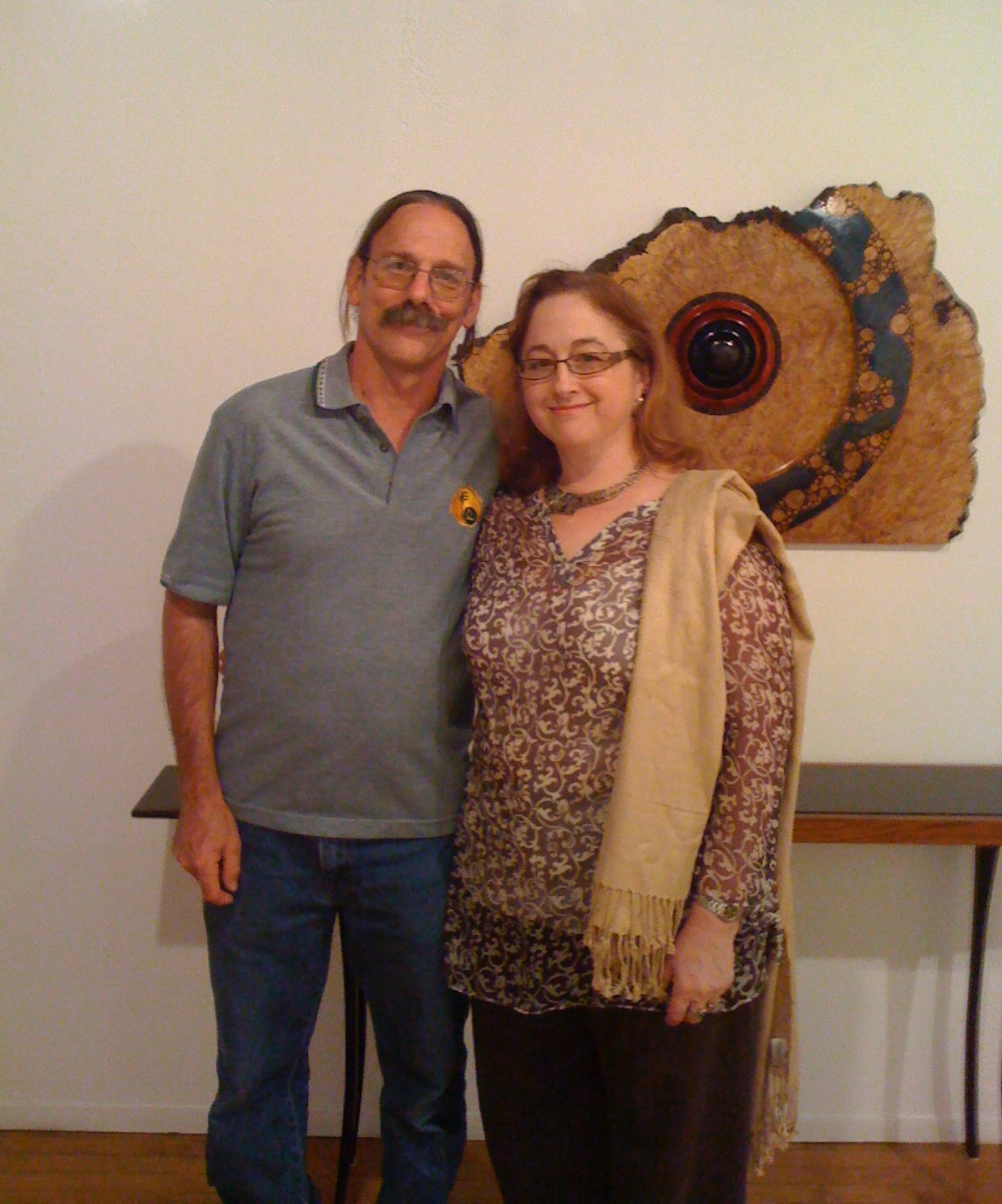
Keith and me at the opening of an art show featuring our work at Buckham Gallery, Flint, Michigan, 2010.
Ralph (left) and Louie, Silken Windhounds, my four-legged guardians.
Ralph (left) and Louie, Silken Windhounds, my four-legged guardians. Photo by Mara Jevera Fulmer

We lay on the soft pillows of the chaise, my four-legged guardians and I, perched upon the second-floor porch as the sun was slowly making its way across the horizon, not yet behind the newly budding trees. Their long shadows cast themselves through the flowering pear tree and its maple tree companion, laying themselves across the practically glowing emerald green grass. A chorus of birds filled the air around me.

I took in all of this magic, lost for a time in its spell, mindlessly stroking the soft fur of my pup Ralph, so silky it stirred a memory. I’d always been enamored by Steve’s hair which had that same silky texture, so fine, yet so playfully curly like a baby’s first grown length of hair. So much alike in that same silky way.

I was drawn back to his last hours, as he lay beside me in the bed. I could hear his slow yet shallow breathing, in…….. out…….. in…….. out…….. in…….. out…….. 

The oxygen generator was tucked away in the next room so as not to disturb us. In the bedroom, his breathing led us in a slow even rhythm, yet barely audible, while the music played softly in the background from the list I’d chosen of his favorite tunes. 

in…….. out…….. in…….. out…….. in…….. out……..

It was meditative in the most compelling way, like a swaying of the body that feels like we’re not alone, but part of a greater living breathing being, slow dancing with the rotation of the earth. 

In the past I have found myself fully embraced in the harmonic moments of similar slow and gentle rhythms. Such was the case when I found myself floating above a coral bommie in the South Pacific, caught in a flowing dance with schools of fish. All the colors of the rainbow, gently swayed with me in the glimmering of life-giving sunlight beaming down from above, yet spread like angel’s wings around us.

in…….. out…….. in…….. out…….. in…….. out……..

Back in the bedroom, I hear the stutter, the slowing pace of his breath. The time is near and I keep my own breath flowing as I listened for his last one. 

in…….……… out………..……..…..

The music ended, too, the last song, “Shake it Up, Baby” by the Beatles….. 

I looked over at him to confirm. “You dawg”, I said to his now silent body. A little laugh bubbled up inside at the awesome irony of his departing message. 

Yet tonight, the cool air now touches me from the setting sun. Ralph, my silken windhound, provides the silky touch of a memory. I remind myself to smile again.

Ralph smiles.
Ralph smiles, and reminds me to, as well. Photo by Mara Jevera Fulmer

Louie, the Silken Windhound, inspects a recently fallen tree after one of Mother Nature’s mood swings with high winds. Photo by the author.

It gets crowded sometimes in my world. My mother’s voice encouraging me to do what I do best. My dad yelling from the other room, “If you can’t do it right, don’t do it at all!” I know he didn’t really mean it as cruelly as it sounded. But my 16-year-old self took it quite hard.

They’re both gone now. But even so, nearly 50 years later, those words still ring in my ears at times, feeding self-doubt as I make my way, once again a widow in the world.

Other voices laugh, whisper, encourage, and cry softly. Keith, my first love, encourages me to take the risks. “Fiji? Why not?” He said. “Sounds good to me!” And so our path was set to the South Pacific, thirty-five years ago, and yet still seems like yesterday. 

Then and now, he sometimes would give me a hard time about being compulsive about things… but I was too timid, really, back then. So bravado sometimes came out instead. Aging without him here beside me these last 14 years has changed a lot of that in me. 

But it has changed him, too. His sometimes harsh teasing in the past has become softer, more assertively encouraging. “Don’t let your own self-doubt, and that imposter syndrome, take you down.” I can hear him whisper gently, but firmly in my ear.

I miss him holding my hand. I miss his hugs that seemed to wrap around me like a shield against the world’s troubles.

Steve, only 10 months gone, walks with me on occasion. Like the distracted child, he is off learning new things, or catching up with old friends in the world gone by, beyond the liminal veil that keeps him just out of my reach. I miss him holding my hand. I miss his hugs that seemed to wrap around me like a shield against the world’s troubles.

But I hear him when he decides to pop up into my head. “Yes! That’s the way. Don’t forget to shim the ends out,” he says. “Be careful to check the length of that screw for that door!” he reminds me, as I begin to install new shades in the living room. Thankfully I understood his guidance, since the barebones instructions that came with the packaging didn’t mention anything. And the Youtube videos were even less helpful.

I walk around the sunlit yard, still cold as Springtime brings Mother Nature’s mood swings. Today 70 and warm, tomorrow freezing with snow, the next day a little warmer again but with a harsh driving wind. But then along comes a dreary grey cold rain… and my mood swings, too. 

And sometimes I just want to stay in bed all day.

Then the visitors come. And they tell me – “Rise and Shine, my girl!” 

“You’ve still got a lot of living left to do! So don’t waste a minute of the life you have! For soon enough, you’ll be on the other side when your time comes, whispering advice to those left behind.”

I pull the covers harder over my head.


copyright 2026 © Mara Jevera Fulmer

Heavy leather belts begin to turn the wheels of the giant Columbia oscillating sander. Photo by author.

He was bobbing around laughing and smiling, his broad chested yet smallish stature accentuated by the 23,000 lbs of 19th century iron machinery that he was tweaking here and there to coax it back to life. It came from an era when the railroad industry was at its height, three drums of varying sandpaper oscillating to prepare the wood, and a fourth drum covered in brushes to clean it off and ready to use.

I sat there watching him, though surreptitiously as I was supposed to be doing my homework for my doctoral program. My books and iPad were perched upon the hand-built wooden table saw that the original owner of this post & beam furniture factory had built for himself complete with little victorian flourishes of details in the handles and guards.

But I just couldn’t help trying to keep track of my new beau Steve’s efforts as he climbed up on top of the giant Columbia sanding machine. Then he would hop down again to check the webbing of more large leather belts and their matching steel pulleys that would have made the machine turn its wheels back in the days of steam power.

I remembered when my husband Keith and I first bought this property, not even two years before. We bought it at first sight, a 20th Century post and beam building filled with many pieces of 19th and early 20th century heavy machinery all used to make furniture. An accomplished woodworker himself, Keith had planned to make it all his. Alas, the stars were aligned differently and he passed away from a very aggressive cancer barely a year after we purchased it leaving me, his widow, to sort out what to do with it all.

And then the stars sent Steve. I think KEITH sent Steve, perhaps after being horrified at my poor attempts to try and sell some of the tools I knew I would never use, but that had left me grifted by his own friend. Steve would become my protector. But perhaps in this case it was not that he had fallen in love only with me, I wondered sometimes. It was this place, where it seemed that many ghosts had congregated to protect the legacy of this old maker space.

I looked up and there was Steve, dancing around the machine grinning from ear to ear.

As I tried to go back to my homework on my table-saw desk, I heard the roar and rattle as the beast came to life. Keith had tried to do this before, but the belts were too loose and fell off within seconds. He never had the chance to go back and try again before his illness had progressed too far.

I looked up and there was Steve, dancing around the machine grinning from ear to ear. As I watched this elfish man jump around this iron giant, he went to one end of the machine where large wood panels would come out, fully sanded and brushed off, ready to use for railroad cars. I snapped a picture of him with the light behind him.

The ghosts that haunt me now. Photo by author.

Later that day I would look again at this photo only to catch my breath. There it was, a ghostly shadow of a slim man leaning over just behind Steve. Keith was there, cheering for the success of this rebirth of this giant, perhaps the last operational Columbia belt-driven panel sander left in the country I’d discovered after further research. I took this rebirthing as a sign that I should never take for granted that I am ever alone on this path. And to accept that my angels are never very far from me, despite the temptation to succumb to sadness. That death of my loved one is not an ending. But a new beginning.

– Mara Jevera Fulmer, February 18, 2026


The “K” at the end of the line. Photo by author.

The above prose was expanded from a 13-minute writing exercise during a six-week workshop offered by @LauraLentzWriter and her Literati Academy. The writers participating in this series are exploring their way through grief and the hero’s journey.

Hammock contemplation with dog. Photo by author

Listen to an audio version of this story below.

He was sitting on the floor, hanging onto my leg, deep fear palpable on his face reflecting the anxiety-ridden content of a note that I was now holding in one hand. My other hand was holding the beachouse phone, the only outside line at our location at this little backpack hostel owned by a friend of mine. I’d brought my students to Fiji, about 18 of them including another instructor who wanted to come along. My husband and oldest daughter among them. I’d been encouraged to design an international study tour to a place I’d lived and worked in, to bring these students from an urban community college in a rustbelt town to the tropical paradise in the middle of the South Pacific.

It was supposed to be a beautiful learning experience, but one also fraught with stress because I had other reasons for coming back. I still had a home here, friends, adopted family. And my immediate family ached to see them again after following the news of political unrest from the previous year. The evidence of that unrest was still apparent in the ruins and graffiti that covered an old lighthouse-turned-restaurant on the coast, outside the capital city.

Workshops had been arranged, visits to cultural sites scheduled, and a student interchange between my Flint students and the university journalism students in Fiji who’d been trying to do their work diligently throughout the turmoil of the previous year. 

The group arrives at dawn. Photo by author

Even an art exhibition was scheduled where my students would share their own conceptual self-portraits on the walls of the national museum, while also learning that week about the work of indigenous artists in the region.

But none of that mattered at the moment. It was only day 1 of the trip and Allan clung to my leg on the floor, fully engulfed in a nervous breakdown that would eventually break me down. The voice on the other end, his mother, sounded in my ear – “Life would be so much easier if I only had one son,” she said. Shocked by her words, I later would learn she was at that moment suffering the shattering of her own mental health.

My next moves were swift. I’d had the forethought to have students sign temporary healthcare POAs since the college I worked for was not yet prepared for overseas study tours at the time. And so I reached out to my old doctor on the island, explaining the situation. He quickly arranged for us to meet with the only psychiatrist in the country at his office near Suva, the capitol, over an hour and a half away. I called my friend, the owner of the beachouse, who’d been renting my home. And he quickly arranged for my dear student’s belongings to be moved to his own private room with a caregiver, a kind Fijian man who served as the gardener most days.

The rest of the trip moved ahead fairly well. His classmates rallied around Allan, including him when he seemed up to participating. And supporting him even after our return to the states. Two other students, Jimmy and Will, became very protective. Jimmy especially would check into the classroom on the days he knew Allan was supposed to be there to make sure he was doing okay.

But about six weeks after our return to Michigan, 9/11 occurred. My dear student had no support outside of school and so looked devastated when I had to tell him that the college was closing and he had to go home. 

In the ensuing weeks, as we all struggled to regain some kind of equilibrium from this post-9/11 new world order, we missed the signs. One Friday, Jimmy came into my office to tell me he hadn’t seen Allan in class the day before. And just as Jimmy went back to work in the lab outside my office, my phone rang. It was Allan’s old girlfriend. 

Her voice crumbled through the phone lines. “He’s shot himself,” I heard her say, just before I screamed myself – “SHIIIITTTTTT!!!!!” The rest of the details laid bare that he had fallen deeply into his psychosis in the weeks after 9/11 while struggling to complete his school work that included a post-travel piece of art. 

His classmates came together again to mourn his loss, struggling to understand the depth of his pain. Later, I would be given his artwork, portfolios, and black books – sketchbooks where he’d plan out his graffiti art. It was among these pieces, I discovered where he was going with his final piece. And in a dream, I saw it completed and I made it so. 

It took nearly a year to put together the final follow-up exhibition. Students struggled to redefine who they were post travel. But who were we after a trip to the other side of the world, meeting others who’d faced unrest in their own backyard? Some had come back thinking that maybe their own lives weren’t as bad by comparison, coming from the rough streets of this former bustling automotive factory town. But 9/11 turned everyone’s world upside down, seeing the attacks on our own country. And even the geographic distance from that horror shrunk further when weeks later, the students learned that their friend had given up on life and ended his.

One student came to me and said, “l’ll need to redo my post-trip self portrait. It’s too balanced, too static,” they said. Life had had too many twists and turns and they needed to reflect that balance as if on the edge of falling.

Beachside meditations Photo by author

Looking back on this group of inveterate travelers from a quarter century ago, this old woman feels something not so much as grief, but awe. The healing gift of time has shown me that Allan’s nervous breakdown and death maybe weren’t bookends that defined a tragic legacy. 

No. With a longer view, I can see it wasn’t a legacy with a tragic ending, after all. Instead, it was the launching of incredible maturing and growth by so many of his fellow students, now adults with established careers and grown children of their own. Longterm friendships were built, regardless of distance, connections that would endure through darkness and light. And most importantly, there was profound resilience. 

Because life is a journey filled with triumphs and tragedies. And the only way to keep upright through it all at the edge of balance is to keep moving forward, knowing that – though we might not always see them – we are not traveling alone.


The above prose was expanded from a 13-minute writing exercise during a six-week workshop offered by @LauraLentzWriter and her Literati Academy. The writers participating in this series are exploring their way through grief and the hero’s journey.