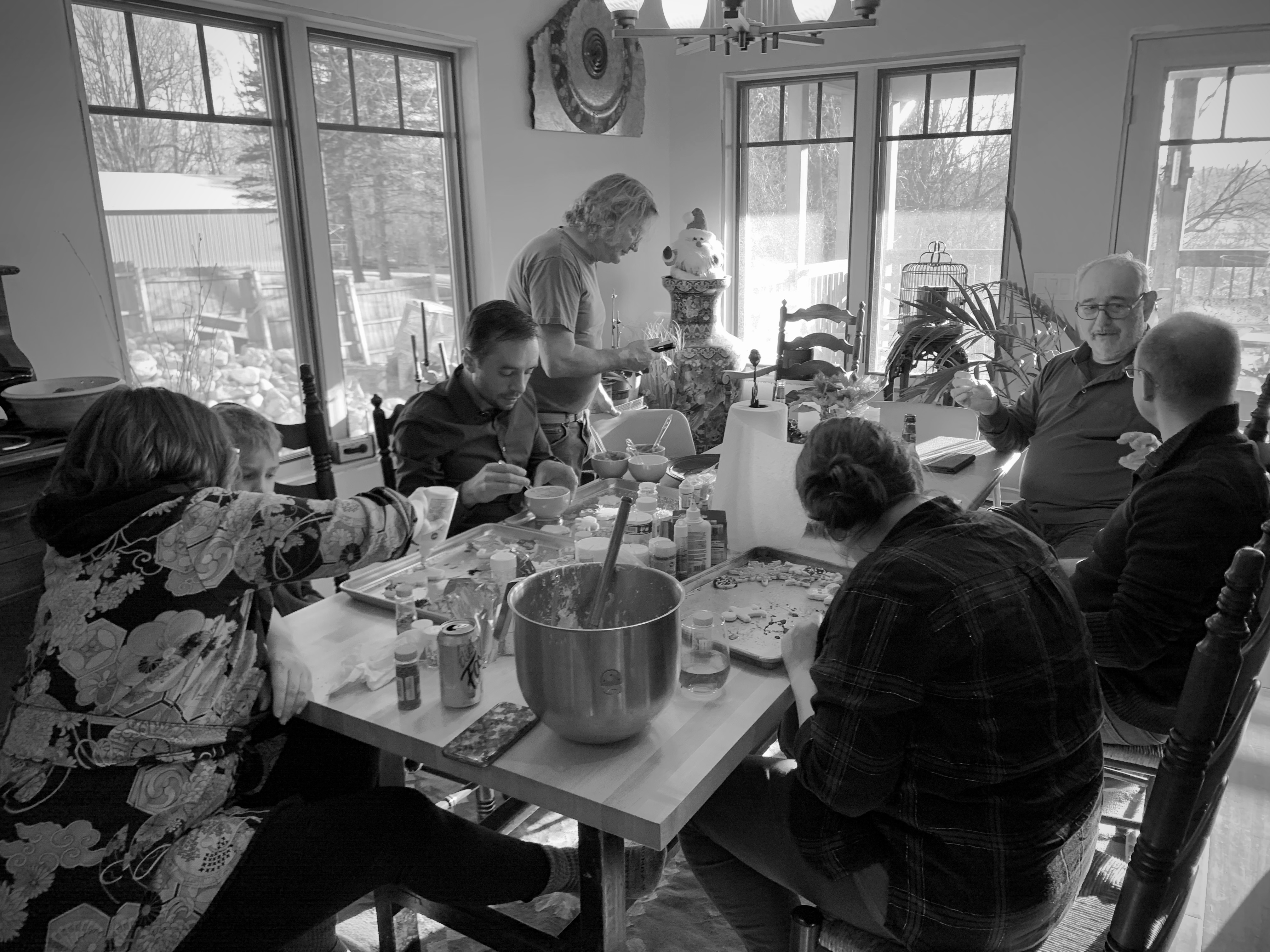
Making food together has been part of a long tradition in my family. Top right seated facing the camera is my dad; standing center is my second husband Steven, with the next generation helping with decorating Christmas cookies. Photo by author.
I am made of the sweet and sour stuffed cabbage of my grandmother Sadye’s special recipe, the kind that you would want to lap up the sauce like soup, layers of cabbage unfolding and refolding around the tender meat inside seasoned so from the cabbage brine, the tomatoes, and the tucked in golden raisins that plumped from long slow cook. It was a healing recipe, carried from the old country, a Jewish twist on the Polish golumpkes… the same, but not the same at all.
I am made from the memories of this and other sweet fruits of her kosher kitchen labors that she would create in the little galley kitchen of her 8th floor apartment. Never mind how much notice we had given her before a visit. There always seemed to be a juicy brisket, some stuffed cabbage, and a plate of Jewish-style chopped liver – recipes that had been carried and fussed over for and among generations standing side-by-side in the making of them.
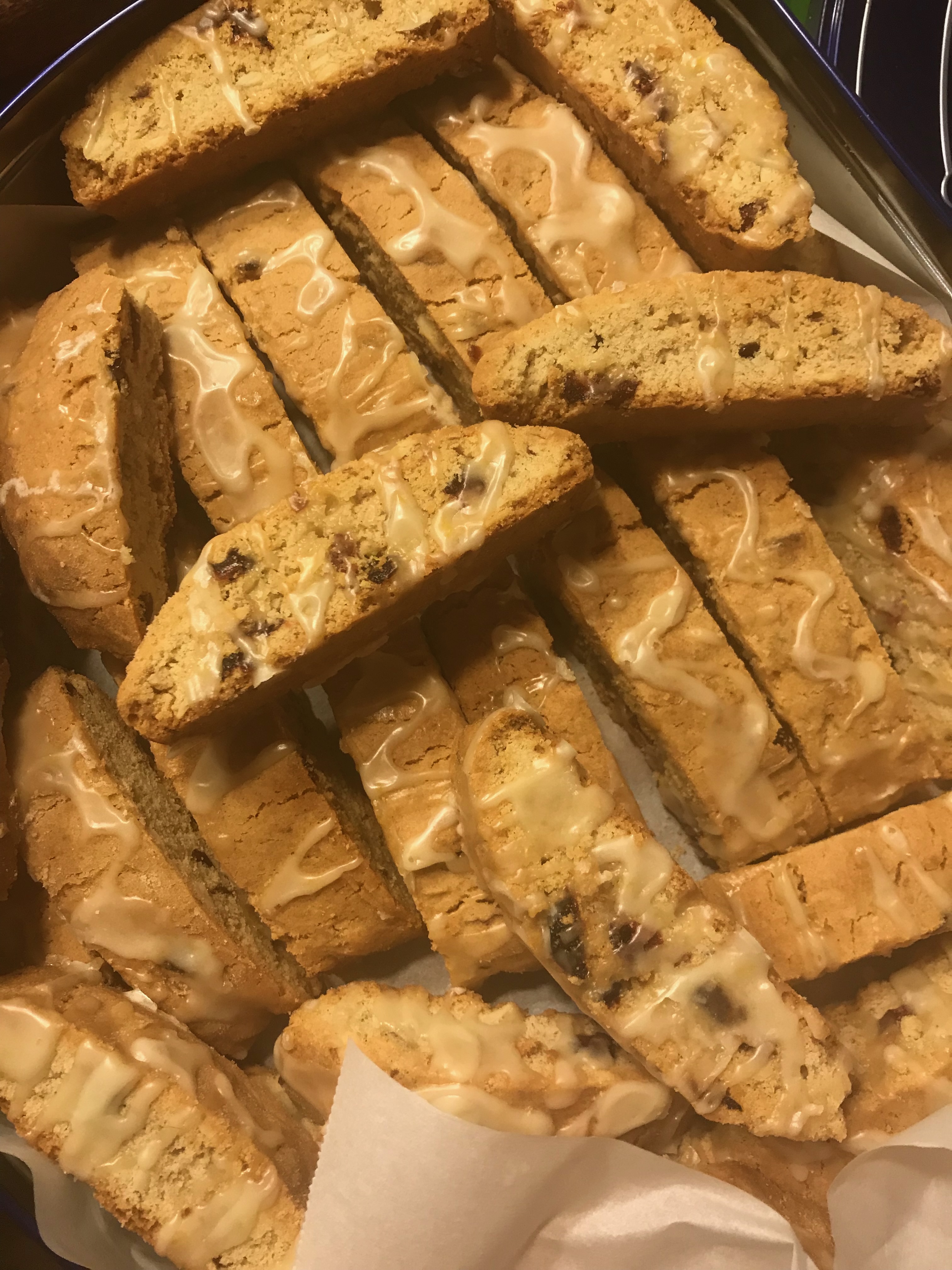
I am made from the sweet crunchy taste of the Mandelbrot, the biscotti of the Jews, that she spent time baking first as a loaf, then sliced and baked again, aromatic with vanilla or lemon, and drizzled with love. A cup of hot tea was its best accompaniment.
I am nourished by the amusing memories of my then fiancé (and later husband of 30 years) Keith who went with me on a visit to my grandmother’s apartment. It wasn’t long before I found Sadye’s petite frame following Keith around the dining room table, in her hand a pretty plate with a mound of chopped liver topped with chopped egg, as is the tradition. “What’s the matter?” She asked him in her most stereotypical Connecticut Jewish twang. “You don’t like chopped liver?” Keith shakes his head vigorously, a good Midwestern boy raised in a Methodist/Baptist household.
As I finished the last batch of Mandelbrot, one with almonds, orange and vanilla, another with chocolate chips, pecans, and dried cherries, neither was a “true” version of the past, but instead a retelling with some modern new flourishes.
Decades later, I found myself re-immersed in Sadye’s embrace in my own kitchen after scouring through my rediscovered childhood recipe cards – and of course the internet – to find the true Jewish grandmother-versions of the recipes my tastebuds could still fully recall. My father sat at my dining room table, anxiously awaiting the treat that I hoped would put into focus the fading memories of his childhood.
As I finished the last batch of Mandelbrot, one with almonds, orange and vanilla, another with chocolate chips, pecans, and dried cherries, neither was a “true” version of the past, but instead a retelling with some modern new flourishes.
A small bite, at first, my father’s eyes opened wide and a huge grin stretched across his face. “YES!” He said. “Sadye would be proud!” he pronounced proudly.
At that, I knew I had done my duty as her only granddaughter to carry forth at least this one small tradition, one baked with love and the many blessings of my grandmother.
Mandelbrot, aka Jewish biscotti, made at home, the batch that truly passed the test. Photo by author.
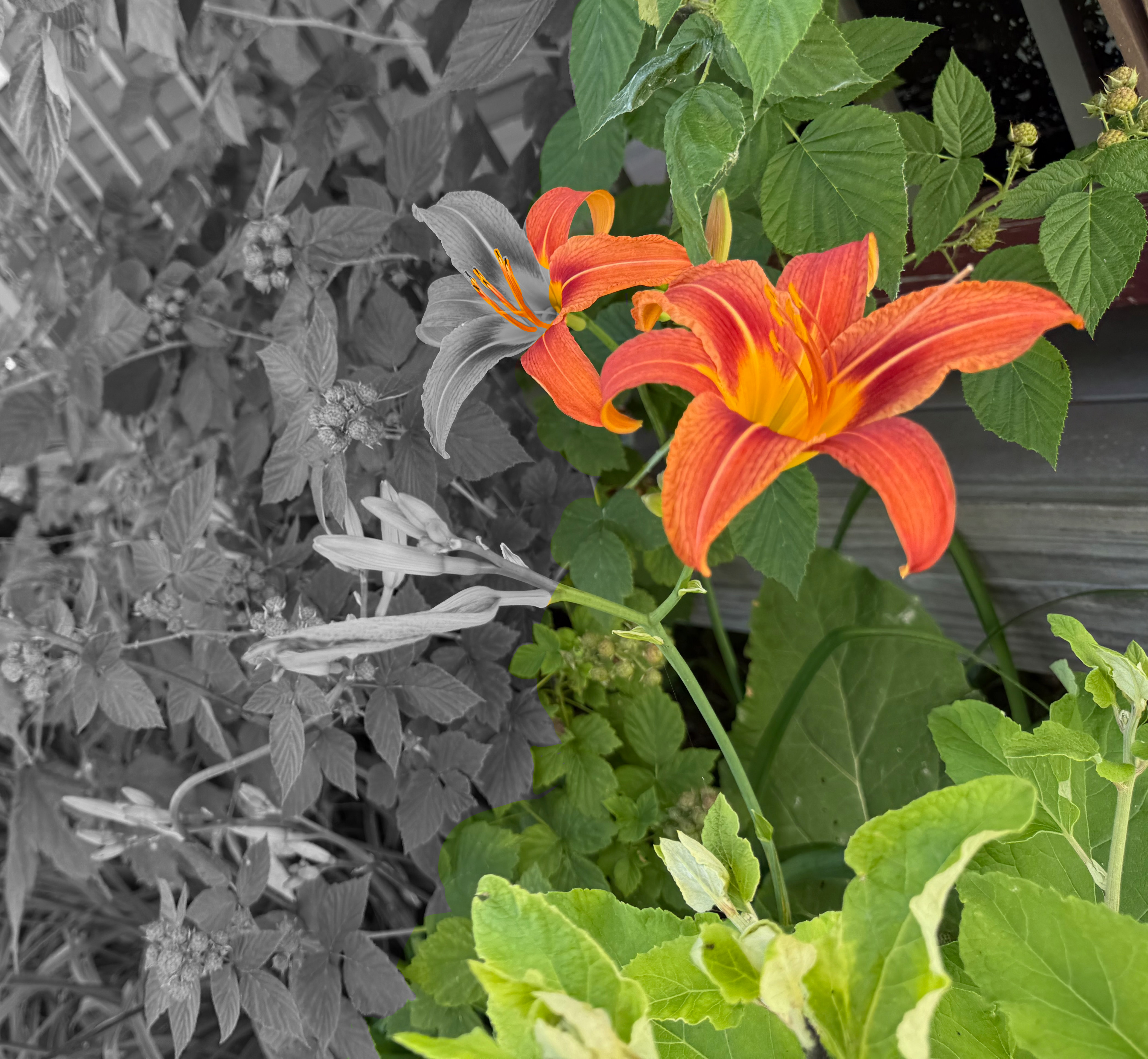
Tiger Lillies and wild Black Raspberries before they’d ripened. Photo by author.
I was laying in bed after another day of active “doing”. The midsummer sun was streaming in just over the trees out the west window of my bedroom. A silhouette of my Valentine’s Day orchid was visible with the promise of future blooms, a first in my experience with these fickle flowers that Keith, the first to make me a widow, loved so much. A framed picture of me and Steven, who made me a widow for the second time, sat on the table beside the plants there.
Ralph was laying down on the bed beside me and I couldn’t help but reach over and gently flip his long-legged body to lay beside me so I could scratch his fuzzy head and back. As I closed my eyes, my fingers reached his softer neck feathers, the fur that helps give the breed their name – Silken Windhounds. The soft texture of his fur has now, as it has at other times, led me to memories of Steven whose hair was so soft and fine and curly that I loved to run my fingers through it, as if touching silk threads.
Ralph, a Silken Windhound, takes his spot in the middle of the bed. Photo by author.
As I lay there, I felt the weight of Ralph on my chest and was taken back to days when Steve and I would lay beside each other in this bed, just resting, listening to music, and to each other’s heartbeats.
We would just “be” in those moments, tender connections, until they would break open and either lead to more intimate connections, or simply a quiet conversation. It would often lead to someone picking up their electronic devices to look something up. And then… the connection shifted to more practical or even creative conversations. Or sometimes nothing at all. And we were okay with that… back to our quiet comfort together.
As I felt his weight, and touched that silky fur, my eyes lightly closed. It was Steven again. And I want to hold him forever. But I knew that in reality, he was not here, and that I was alone. Just me and the two pups.
The Sounds of Memory
As I tried to remember Steve’s voice… searching my memory banks, a slight panic began to bubble up. What if I couldn’t remember what his voice sounded like? I have videos of him on my phone and computer, I remind myself. But I knew it wasn’t the same.
Steve’s voice was a mid-alto that went higher when he laughed or giggled. I always found that giggle so cute, even amusing at times, with those high treble giggles he made that could sound like a little girl. Yet his laugh was so genuine and sweet, a little boy still inside the smiling old man. It was hard to resist its charms.
The screen of my unfolding memories begin to split and I hear Keith’s voice which was more of a low alto, his voice deeper, more resonant. You always had to listen for the smile in Keith’s voice to match the subtle smiles that would often flit across his face, especially amidst the seriousness he took for his work. Because it sometimes wasn’t easy to tell if he was being lighthearted, or making a stinging rebuke. That line was often difficult to discern.
When Keith did smile, it was like sunlight shining through. In our later years, I saw more of that sunshine than darkness as we both began to cast off our former insecurities of youth, trading them for the willing embrace of another chapter to come.
Rewriting Chapters
That chapter had a plot twist, as did the next chapter written after the first turn. I see them side by side sometimes. The wrapped blanket around a dismantled table of Keith’s. Sitting on the second floor of the remodeled Gallery House building that I’d just finished… on my own… without him… I slipped down the wall to sit on the floor, overcome with grief as the shape of that table wrapped in the moving blanket looked so much like the profile of Keith’s frail boney dying body laying with his back to me in the hospital bed set up beside our marriage bed… as I watched for telltale signs of life… soon gone.
I see the screen split with the empty space now on Steve’s side of the bed. I lay here tired after a few days of “doing”… things I would have done WITH Steve. Or with him guiding me, or me helping him. We were a good team.
Instead, I was doing these things on my own. Making a list of what needed to be done, projects big and small. The small ones I could do myself – or a least mostly. The bigger projects I needed to put on my contractor hat and work out the details with someone with the right skillset.
So it was one of these smaller but doable projects where found myself completely defeated, taken down by a simple wall anchor in an attempt to hang shelves in a small closet. Once I recovered from the thorough humiliation, I asked Lizzy for help. Normally very up to doing things with me, my former student took over the planning and installation of the wall anchors themselves, while I managed the gathering of any other items.
Yet I noticed that even Lizzy was tiring easily from months of struggling with her own health demons, though less than half my age. Too young for that, my heart sank in empathy. The body keeps the score and hers holds a lot of trauma.
As I watched her struggle with one of the screws going through the shelf bracket and into the wall anchor, I realized I knew some things about the impact driver that I could teach her, things I had learned from Steve, and that I could pay forward.
As I watched her struggle with one of the screws going through the shelf bracket and into the wall anchor, I realized I knew some things about the impact driver that I could teach her, things I had learned from Steve, and that I could pay forward. Steve could be always be counted on for the generosity of his gifts of knowing how to do “the things,” a (mostly) patient teacher, at least with me. I was most grateful for this patience and willingness to teach me things, and would often tell him so.
Men at Work
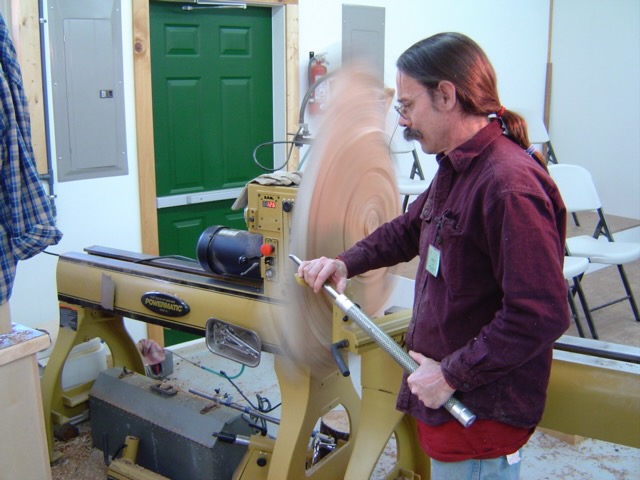
The screen splits again and I see them each in their element. Keith fully inside his head, concentrating deeply on turning a bowl on the lathe, tik tik tik tik tik tik tik tik… the sound of the gouge hitting the wood as he smoothed the wood into a more cylindrical shape. Often wearing a full protective mask over his head and face, I was careful never to disturb him for fear he’d shift his view and either ruin his work, or worse, have it break off the lathe and fly into him or smash across the wall. And knowing how much he loved what he was doing, I couldn’t forgive myself if I put him or his work at risk.
Keith, c. 2007, at a workshop demonstrating a woodturning technique using the outboard in order to create a large wall-hanging piece. Photo supplied by author. Photographer unknown.
Steven, on the other hand, would often invite me in to see what he was doing. I’d even ask him to show me things. I’d grown up in the era when girls took Home Ec classes, and boys did Shop class. Traumatized at a young age by my father’s own bloody run-ins with power tools, especially those with blades, I was determined to face my own fears. So Steve gave me some key pointers on the table saw, as well as a jig saw, and a chop saw. And I got pretty good with my own letterpress type saw, too. Even so, I lacked Steve’s (and Keith’s) deeper understanding of woodworking techniques and their cautionary tales.
But I’m tired now. Three days in a row of “doing” is enough.
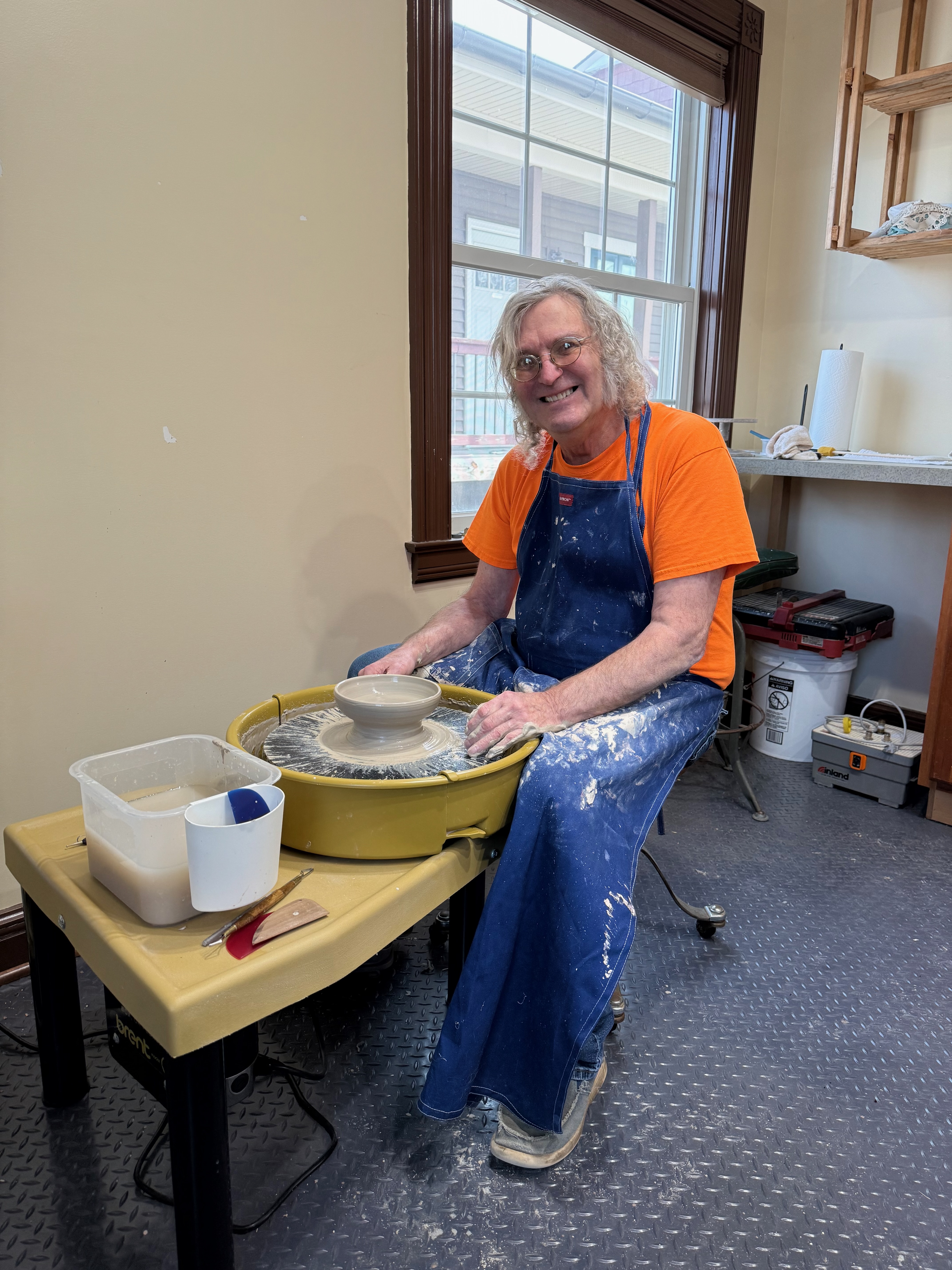
Steve, after already diagnosed with stage IV lung cancer, embracing his new potter’s wheel. Pottery was one of his favorite creative outlets. Photo by author.
Three Days of Doing the Things
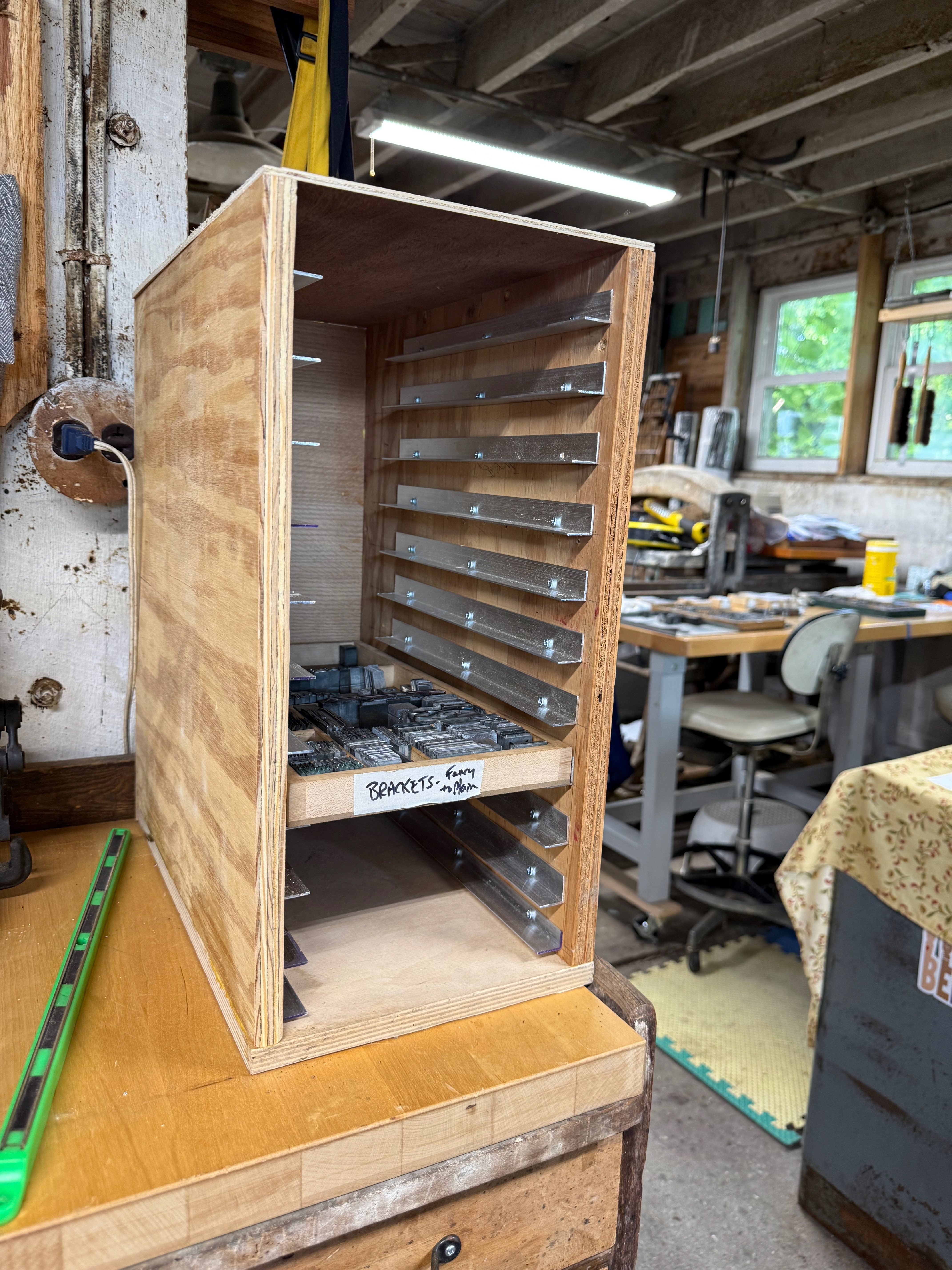
Day One – To Gather and Prepare: To take my mind off my utter failure with wall anchors, I was going to make a “Quartercase cabinet.” This is a little letterpress cabinet that held small cases that I would fill with type ornaments. Smaller is better for the size of these cases since the type is lead antimony and the weight adds up quickly. I’d come up with a design based one I already had in the shop.
First there was a full day of planning, buying, and cutting aluminum L-rails that I would use to hold the small type cases in my Quartercase Cabinet. I needed to buy the 4’ and 6’ rails along with the right jigsaw blades to cut metal.
I missed the old men at the Ace hardware who could tell you whether the blade was the right one for a Dewalt jigsaw even though the blades were Bosch brand. The young ones didn’t have a clue.
It took two trips to the hardware store where I learned how much I missed their employ of knowledgeable people. I missed the old men at the Ace hardware who could tell you whether the blade was the right one for a Dewalt jigsaw even though the blades were Bosch brand. The young ones didn’t have a clue. And on the second trip to return the first blades purchased, I finally remembered to buy an 18” level since two other projects I intended to work on were in a space just shy of 24”. So the two 24” levels I’d found on my searches around the homestead wouldn’t be useful there. And the 9” torpedo levels were just too small.
Armed with the right blades, my day of cutting 24 aluminum rails went fairly smoothly, almost like I knew what I was doing. I finished them off by drilling three holes on each piece so they could be screwed to the wood cabinet. I left the workshop feeling satisfied and headed back into the house to enjoy the literal fruits of my labors from earlier in the day making wild black raspberry chipotle BBQ sauce. I’d tossed some of it into a bowl with a small chuck roast that I had cooked in the 2-quart crockpot I’d purchased when I realized cooking for one really meant thinking smaller. Over the previous few days I had managed to pick over a quart of berries from a volunteer plant that grew in my front garden and was still producing for another couple of weeks.
Day Two – Wooden Encounters: My goal for this day was to cut all the wood pieces for the actual cabinet and then build it. Measure twice, cut once. But the sign in the shop says “Measure once, cuss twice” which turned out to be more accurate than I intended. Even so, I had to chuckle as I still double checked each measure I made based on my plans I’d drawn earlier.
The cutting of my first piece went well. I was using nothing but scrap sheet lumber from around the shop and garage. And 3/4” or 5/8” plywood would do the job for the sides and bottom. The top and back could get away with being 1/4” ply that seemed plentiful around the shop.
When I made that first cut on the lighter ply, I reached down with my left hand to shut off the saw. Both Keith and Steve had the same saw, but Steve’s was set up with a left-hand shutoff since he preferred it. Stassia, my younger daughter, had ended up with her dad’s table saw. But as I reached down, the piece of 1/4” ply flipped up and flew across the moving saw blade and then hit me on the left wrist. Apparently I hadn’t pushed the piece fully away from the blade and it sucked it back and sent it flying. OUCH!!! Lesson learned.
Nursing my bruised wrist, I was thankful that it wasn’t worse. No broken bones, no blood. Just a nasty bruise that was helped later by ice and some CBD/THC lotion left from Steve’s treatment stash when the cancer had moved into his spine. A few days later, the bruising in the deeper tissue further up my arm started to show, confirming why it all felt a bit tender.
A bit of bruising. It could have been a lot worse. Photo by author.
After a few choice words, I went on with my project, making other far less dangerous mistakes along the way. Like putting all of my new rails in the wrong orientation, then having to take them all off and move them to the right position. I could hear both Keith and Steve shaking their heads with a slight rebuke – “Why didn’t you read your own plans?” Yep. Lost nothing but time and I had plenty of that, as long as my back held out.
The rest of the project went better, though far from perfect. Remembering when to grab some wood glue, getting out the longer bar clamps, using gravity to help when my strength would sometimes fail me. I put both my battery powered Dewalt drill and impact driver into hard use that day. But in the end, I got it figured out, and I was able put together something useful. My grief turned briefly to gratitude for the split screen guidance from beyond that I received throughout the day, especially the encouragement not to give up.
My finished Quartercase Cabinet. Not perfect, but fully functional. Photo by author.
Day 3 – Revisiting my nemesis: Lizzy came over and we revisited the wall anchors that had taken me down the previous week. By the time we were done, after the struggles I noted, we both felt satisfied with the results. Though we did use one less shelf, removing the one I’d messed up in my first attempt, leaving the drywall mess from my earlier misadventures with wall anchors for another day.
Success! Only the remnants of drywall anchor damage at the top. Photo by author.
Blurred Vision
That brings me here to this moment, to the edge of tears, to the split screen visions of my two loves. And to the still raw grief of missing Steve, even more deeply than I’d felt in awhile. It’s been just over 13 months and I know he wasn’t ready to give up, a fighter until the very end, my dear knight. Even so, I am grateful for being able to carry forth these split screen conversations, even if they sometimes bring with them some deep pangs of grief. The connections of love still provide a healing balm that helps me get up for yet another day of “doings”.
An Rx for Joy
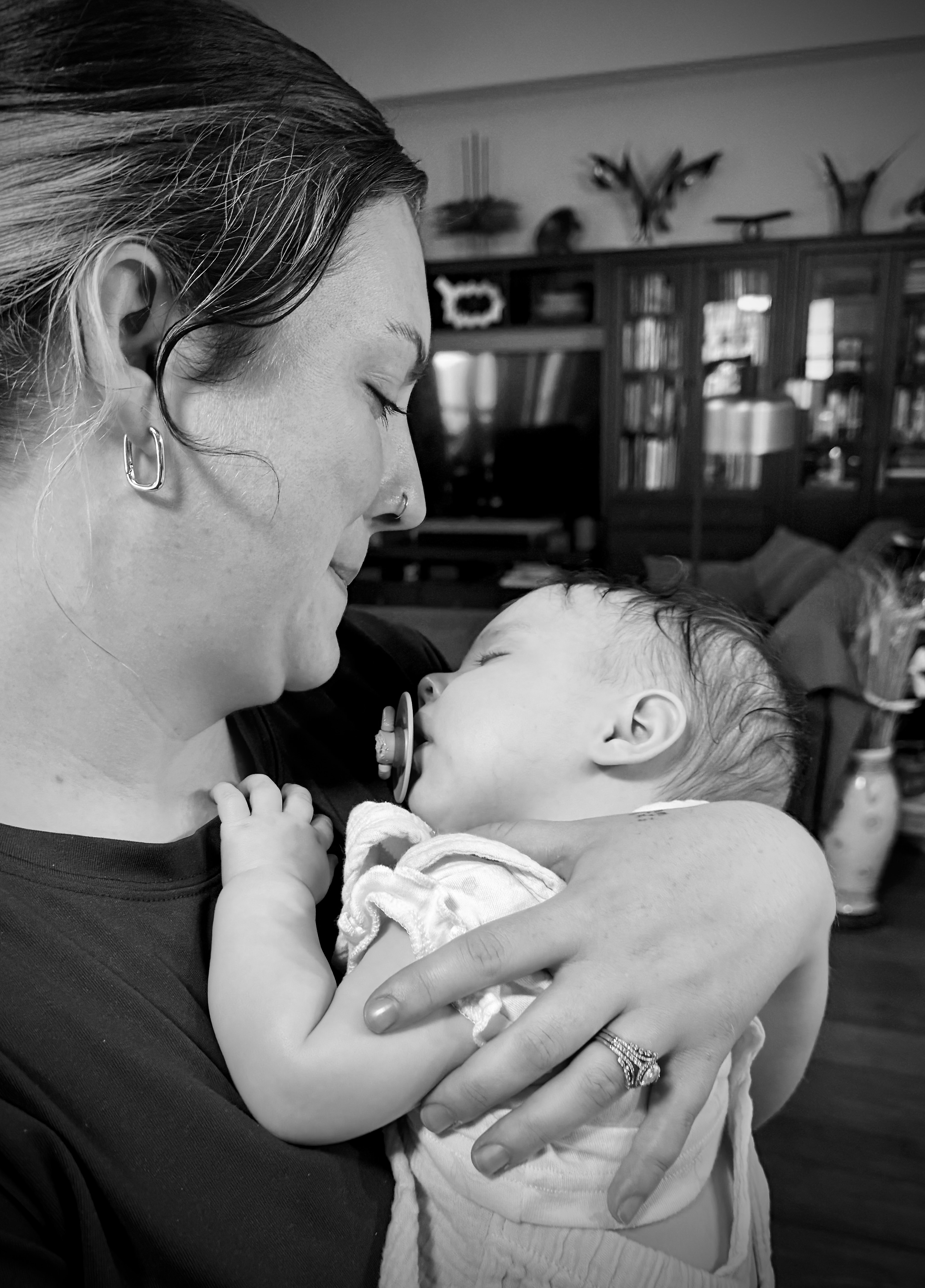
Today another of my former students, Ella, had reached out wanting to visit and introduce me to her 7-month-old baby daughter. When the car pulled up into the driveway, I couldn’t help myself. Asking first, I carried this dear sweet darling into the house and just did my best to absorb her sweet babyness. I wanted to just drink up all that love, joy and innocence. Just witnessing the start of a new life with all of the possibilities of the future ahead of her, I felt my cup overflowing with joy.
And then…I rested.
It’s hard not to fall in love with this little darling, quite literally a little bundle of joy! Photo by author.
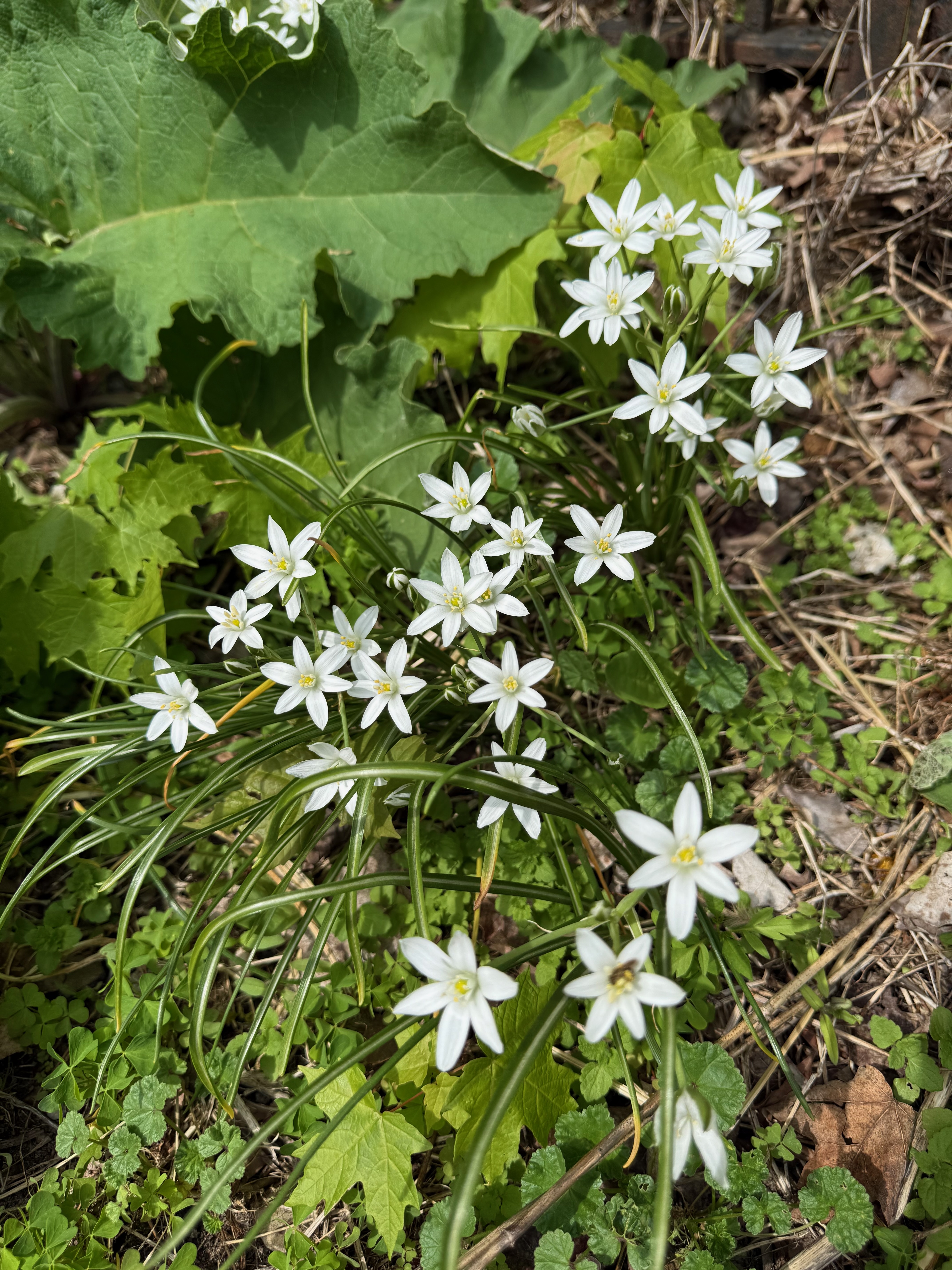
Star of Bethlehem, aka Grass Lillies, growing amidst the rhubarb and weeds in the unkempt vegetable garden, May 2026.
It’s different this time. I’ve been here before. A second-time widow now 14 years older, wiser, more prepared for the storm ahead. I knew I could fall deep into the wake of sadness.
Back when it was my first time, I thought I would die from the pain, so deep, so shattering I couldn’t imagine life going on.
I was in Yekaterinburg, Russia teaching on a Fulbright grant when I first got the news of this diagnosis. Keith hadn’t been getting better, even saying its just a lingering case of bronchitis. He promised me he’d go back to his doctor as he dropped me at the airport and we kissed goodbye.
As studious as I was, I was uneducated in the lingo of cancer, or the many euphemisms it could go by. Sitting in my hotel, and so unnerved by Keith’s ambiguous yet clearly unhopeful words he’d texted to me, I was desperate to reach back out to him.
I found a way to make a phone call over Skype by paying for a phone number. When the call went through, I could hear how surprised he was when he saw the local number but heard me talking to him from over 5000 miles away in the middle of Russia. But I had to hear his voice. I had to make sure I wasn’t overreacting.
I could hear his weakened voice muddied by exhaustion from tests he’d undergone while I had been away, unplanned but supported by my daughters. Metastatic Liver Disease, he said, though I wasn’t sure what he really said until it sunk in minutes later.
“That doesn’t sound good,” I replied.
“Nope”, he reluctantly and quietly agreed.
“Do you want me to come home?”
“Yes,” came the nearly whispered reply.
And at that I knew how serious it was. Usually the midwest stoic, Keith had always pushed through and never asked me for help when it came to his healthcare. But not this time. Now, he needed me and I was on the other side of the world.
Usually the midwest stoic, Keith had always pushed through and never asked mefor help when it came to his healthcare. But not this time. Now, he needed me and I was on the other side of the world.
As I ended the call, quiet “I love you’s” exchanged, I felt trapped. I needed to scream, to cry, to shout. But I feared being seen as the crazy American in this industrial Russian city. I already was pretty much the ONLY Amerikanski here.
I took a different route and had the good sense to go and cry in the shower so few could hear me. But as the water poured over me in the modern white subway-tiled shower, I slid down the wall into a pool of tears and rain shower droplets, trying to cleanse myself of this deep despair.
That was the start of the first time, and the most painful, most despairing experience of my life. The only thing that kept me from ending my own was the knowledge that my own daughters needed their me, their mom. I needed to get home.
Fast forward to the present.
Here I am, now wrapping up a year into my second term as a widow. So many projects left undone. So many questions I would ask Steve as I tried to take my first steps. But the springtime came anyway. And now I stare out at the untended and unplanted vegetable garden patch where we would have tilled and replanted our tomatoes, and beans, and spinach.
Me and Steve, fishing from the shore after we’d sold the boat about a year after he was diagnosed with Stage IV lung cancer, June 2024, Big Fish Lake, Ortonville, Michigan.
It has been hard, for sure. I loved Steve dearly, my second husband, in a different kind of love than my first husband. As an older relationship, we were not hampered with career growth, or raising young children. All adults, Steve brought six children to my two. And they came with their various partners, and growing families. Together, we enjoyed a life we built that was happy, supportive, loving, playing creatively, like two overgrown kids.
When the diagnosis came, Stage IV Lung Cancer, something switched on for me. Survival mode. There were Caregiving tasks that needed to be addressed. Appointments to be made, and people to keep in the loop.
Over the next 2-1/2 years, PTSD from my earlier loss would creep in. But I managed to keep my outward crying to a minimum. We would use whatever time we were gifted to try and continue to live a happy life together, with as much or as little as was required to do that, even if it was just sharing a sweet smile, a loving embrace, and the quiet “I love you’s”.
I realized that what I feared, even more than losing Steve, was also losing this beautiful family he had brought with him. And most directly, losing Sam and his family who had become close to my own older daughter’s family, and who would visit often, despite his long distance. When I shared this with Sam, I was met with a loving reassurance that we’d always be family.
His last few weeks were both physically and emotionally challenging. Ups and downs, exhaustion, tears, laughter, and moments that could be the making of a comedy skit. That is, if it weren’t the end.
His last few weeks were both physically and emotionally challenging. Ups and downs, exhaustion, tears, laughter, and moments that could be the making of a comedy skit. That is, if it weren’t the end. So when Steve died, a sort of numbness took over that was somewhat familiar to me. It served me well enough as I got through the first months after his passing. It is a type of emotional survival mode that would carry me through the worst of it. My caregiving duties were over. Now I could sleep through the night and work on caring for myself.
Between the chaotic weather and my aching back, I’ve given myself permission not to replant the whole vegetable garden. Maybe I’ll just do potted tomatoes and herb plants on the upper deck again this year.
Now, as I looked out at all the various weeds overgrown from my second-story perch, I couldn’t make out what is really there in the untended patch. It just didn’t look like a vegetable garden anymore. On my next walk around at ground level, I made a point to check into the weedy fenced-in patch, ignored and now mocking me with the warming weather after a long cold dark winter.
To my surprise, the already overgrown rhubarb persists even now, despite a decade or more of neglect. It was first planted on other parts of the property by the original 19th Century owners of the property, and has survived constant disruptions of the land over the last 180 years.
And amidst the weeds that filled in the gaps around the rhubarb, starlike white flowers peaked through their thin green leaves that I’d never seen here before. These abundant patches of Star of Bethlehem grass lilies sparkled with hope as the season of new life and purpose unfolds before me.
To make sure I take care of myself in this new chapter, I remind myself to lean in on my toolkit for grief. It is one developed from years of practice living with hope, death and respair, a long forgotten word meant to describe finding fresh hope after despair.
And so, it is is with respair in mind, that I share this toolkit for navigating a journey through grief:
Practice compassion. For yourself, as well as others. You never know if the one you’re speaking to is going through a difficult time, as well.
Breath. Never forget to. When I was learning to scuba dive, the instructor knew that when the beginner diver goes under water – complete with all the breathing gear – their instinct is to hold their breath. We can’t keep holding our breath, even when we may feel like we’re drowning in grief. Just… breath.
Feel all the feels. There is no timeline on grieving. There is no schedule for it. Something triggers a memory – a song, a bird, a word – and the wave overtakes you. And you find yourself in a puddle of tears. Let it out and after the tears, a lightness may take over.
No one can take away your grief. But having a friend or companion who is a good listener can definitely help. And if that’s not doable, for whatever reason, find a compatible therapist, an objective listener trained for just such purposes.
Scream and cry if you must. Do it safely so that you can still wake up to another day.
Read a good book. Even when it makes you cry. Joan Didion’s “Year of Magical Thinking” brought me all the feels. I needed to know I wasn’t alone in these experiences.
Make something new. There’s a certain spark that comes with a new adventure, no matter how small.
Make something familiar. There’s comfort that comes with revisiting the familiar tasks that become your meditation.
Write it down. Share your story in the written word, as much or as little as you need to. Writing it down is like casting it off into the stars.
Take a walk, if you can. Especially in nature. This afternoon, I could admire the Star of Bethlehem grass lilies that found ways to create a sparkling view, even in the midst of my untended and unplanted vegetable garden.
Cry, dance, and sing when the music plays.
Grant yourself grace. Especially on the days when it seems too much.
Practice smiling again. It may feel awkward at times, but eventually it will become natural again.
Give yourself permission. To cry, to love, to be happy…
Talk to him/her. They’re still listening.
And as time passes, be open to the growing possibilities of future happiness in life.
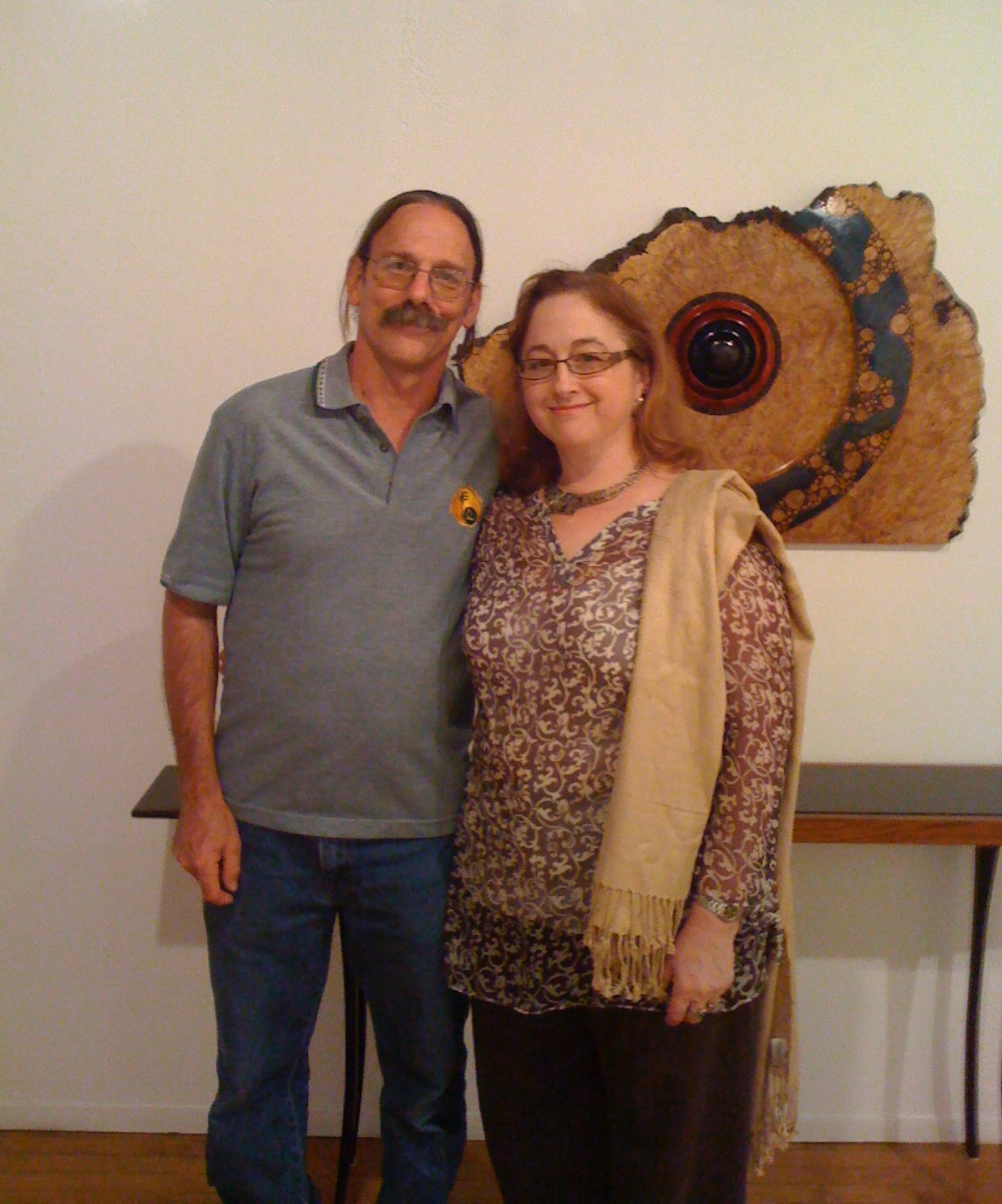
Keith and me at the opening of an art show featuring our work at Buckham Gallery, Flint, Michigan, 2010.
He was sitting on the floor, hanging onto my leg, deep fear palpable on his face reflecting the anxiety-ridden content of a note that I was now holding in one hand. My other hand was holding the beachouse phone, the only outside line at our location at this little backpack hostel owned by a friend of mine. I’d brought my students to Fiji, about 18 of them including another instructor who wanted to come along. My husband and oldest daughter among them. I’d been encouraged to design an international study tour to a place I’d lived and worked in, to bring these students from an urban community college in a rustbelt town to the tropical paradise in the middle of the South Pacific.
It was supposed to be a beautiful learning experience, but one also fraught with stress because I had other reasons for coming back. I still had a home here, friends, adopted family. And my immediate family ached to see them again after following the news of political unrest from the previous year. The evidence of that unrest was still apparent in the ruins and graffiti that covered an old lighthouse-turned-restaurant on the coast, outside the capital city.
Workshops had been arranged, visits to cultural sites scheduled, and a student interchange between my Flint students and the university journalism students in Fiji who’d been trying to do their work diligently throughout the turmoil of the previous year.
The group arrives at dawn. • Photo by author
Even an art exhibition was scheduled where my students would share their own conceptual self-portraits on the walls of the national museum, while also learning that week about the work of indigenous artists in the region.
But none of that mattered at the moment. It was only day 1 of the trip and Allan clung to my leg on the floor, fully engulfed in a nervous breakdown that would eventually break me down. The voice on the other end, his mother, sounded in my ear – “Life would be so much easier if I only had one son,” she said. Shocked by her words, I later would learn she was at that moment suffering the shattering of her own mental health.
My next moves were swift. I’d had the forethought to have students sign temporary healthcare POAs since the college I worked for was not yet prepared for overseas study tours at the time. And so I reached out to my old doctor on the island, explaining the situation. He quickly arranged for us to meet with the only psychiatrist in the country at his office near Suva, the capitol, over an hour and a half away. I called my friend, the owner of the beachouse, who’d been renting my home. And he quickly arranged for my dear student’s belongings to be moved to his own private room with a caregiver, a kind Fijian man who served as the gardener most days.
The rest of the trip moved ahead fairly well. His classmates rallied around Allan, including him when he seemed up to participating. And supporting him even after our return to the states. Two other students, Jimmy and Will, became very protective. Jimmy especially would check into the classroom on the days he knew Allan was supposed to be there to make sure he was doing okay.
But about six weeks after our return to Michigan, 9/11 occurred. My dear student had no support outside of school and so looked devastated when I had to tell him that the college was closing and he had to go home.
In the ensuing weeks, as we all struggled to regain some kind of equilibrium from this post-9/11 new world order, we missed the signs. One Friday, Jimmy came into my office to tell me he hadn’t seen Allan in class the day before. And just as Jimmy went back to work in the lab outside my office, my phone rang. It was Allan’s old girlfriend.
Her voice crumbled through the phone lines. “He’s shot himself,” I heard her say, just before I screamed myself – “SHIIIITTTTTT!!!!!” The rest of the details laid bare that he had fallen deeply into his psychosis in the weeks after 9/11 while struggling to complete his school work that included a post-travel piece of art.
His classmates came together again to mourn his loss, struggling to understand the depth of his pain. Later, I would be given his artwork, portfolios, and black books – sketchbooks where he’d plan out his graffiti art. It was among these pieces, I discovered where he was going with his final piece. And in a dream, I saw it completed and I made it so.
It took nearly a year to put together the final follow-up exhibition. Students struggled to redefine who they were post travel. But who were we after a trip to the other side of the world, meeting others who’d faced unrest in their own backyard? Some had come back thinking that maybe their own lives weren’t as bad by comparison, coming from the rough streets of this former bustling automotive factory town. But 9/11 turned everyone’s world upside down, seeing the attacks on our own country. And even the geographic distance from that horror shrunk further when weeks later, the students learned that their friend had given up on life and ended his.
One student came to me and said, “l’ll need to redo my post-trip self portrait. It’s too balanced, too static,” they said. Life had had too many twists and turns and they needed to reflect that balance as if on the edge of falling.
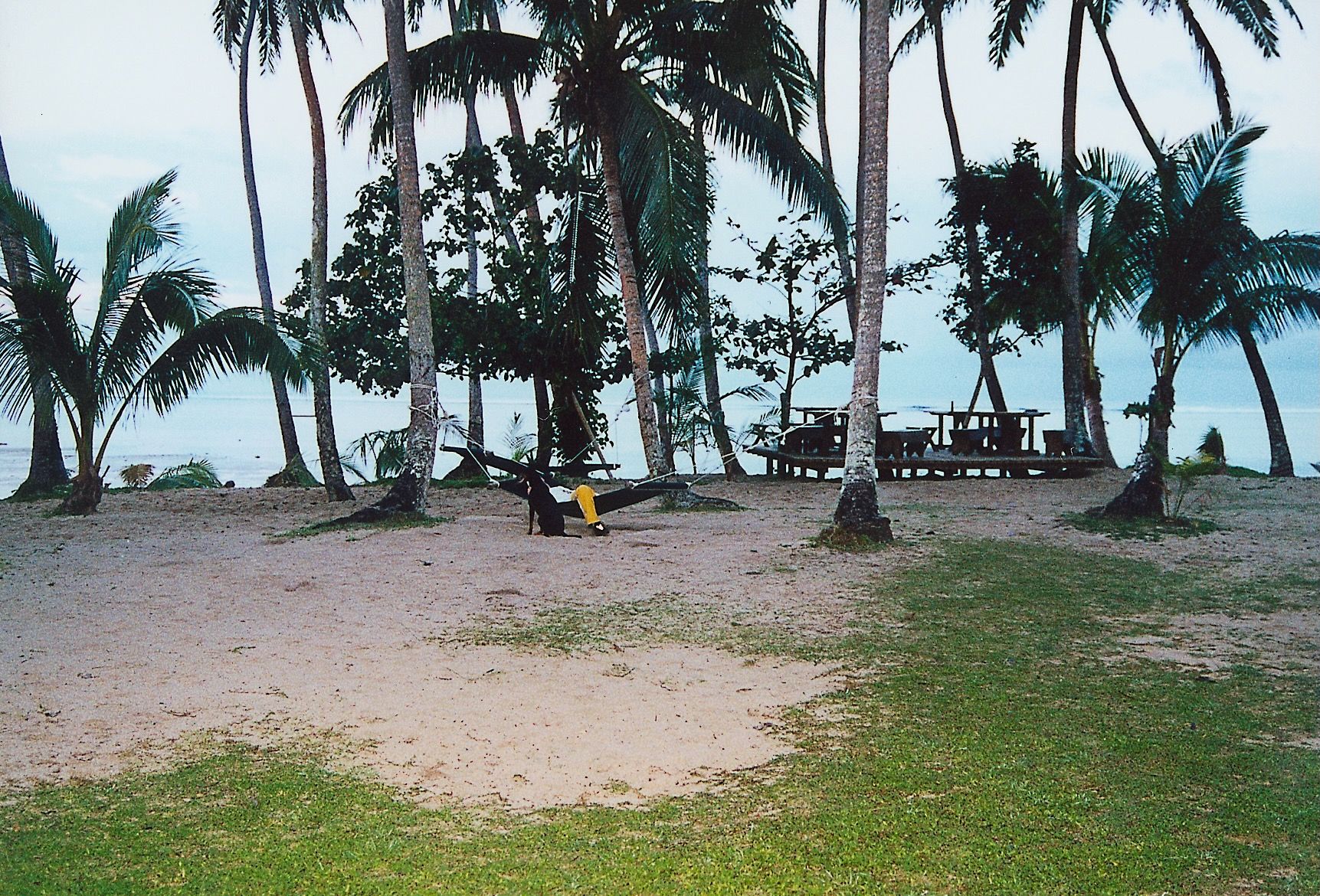
Beachside meditations • Photo by author
Looking back on this group of inveterate travelers from a quarter century ago, this old woman feels something not so much as grief, but awe. The healing gift of time has shown me that Allan’s nervous breakdown and death maybe weren’t bookends that defined a tragic legacy.
No. With a longer view, I can see it wasn’t a legacy with a tragic ending, after all. Instead, it was the launching of incredible maturing and growth by so many of his fellow students, now adults with established careers and grown children of their own. Longterm friendships were built, regardless of distance, connections that would endure through darkness and light. And most importantly, there was profound resilience.
Because life is a journey filled with triumphs and tragedies. And the only way to keep upright through it all at the edge of balance is to keep moving forward, knowing that – though we might not always see them – we are not traveling alone.
The above prose was expanded from a 13-minute writing exercise during a six-week workshop offered by @LauraLentzWriter and her Literati Academy. The writers participating in this series are exploring their way through grief and the hero’s journey.
We’d just begun a new chapter of being just the two of us again, children grown, new challenges and opportunities… after 34 years together, like young newlyweds, the world would be our oyster again hiding the pearl we knew would glimmer and shine its lustrous colors upon us. I’d rushed back from an overseas trip only to find myself now in charge of your healthcare.
And then you were gone.
So abrupt, from diagnosis to death in less than three months.
Crushed, angry, resentful for you having left me right when the adventures were getting even more interesting than the 30+ years before!
I restarted my studies, knowing that if I just immersed myself in the work I could hide away from my grief, ignore the wound in my heart. But by Christmas, I sat crying on the side of the bed…
I just. want. a hug.
I’d tried a dance class, a restorative process where I could lose myself in the movements, and connect to my grandmother, a dancer in her own day. You never wanted to dance with me… though there was that one last time. But still, the movements and the music began to heal me.
I don’t bite except on Tuesdays and Thursdays.
The dreams were so vivid that I looked forward to your visits. But the loneliness wouldn’t go away. Perhaps, if only there was someone, not one of our children, or friends, or anyone who knew you. Someone I could talk to who didn’t have your ghost to guide the conversations.
And then he reached out and I ignored him. Each week he’d check in. “I don’t bite except on Tuesdays and Thursdays,” he wrote. And I finally couldn’t stifle the laugh. The nerve, I thought. So we wrote to each other, first just a couple of times a week, then every day, and then we’d talk all night.
“I wish I could dance with you, ya know,” he wrote offering to join me in a dance class when he visited. It became our connection. He was awful at it, and I loved him for it anyway.
As we shared our stories with each other I realized it wasn’t just my tears that were falling for the one I’d lost. He cried for it, too, a life of wonder and adventure that he hoped to build with me.
And then… we did.
The above prose was written as part of a 13-minute writing exercise during a six-week workshop offered by @LauraLentzWriter and her Literati Academy. The writers participating in this series are exploring their way through grief and the hero’s journey.
This is an icon I created when working in Fiji. It was one of 24 icon-style illustrations with Pacific themes. Being my favorite, I adopted this one as a psuedo-logo.