It’s Steve’s 69th birthday today, or at least it would be if he were still here. I woke up angry this morning, ostensibly from an angry dream. I remember being in the position of selling a bunch of stuff… perhaps an estate or garage sale. I know this is a pressure I’ve been dealing with on and off but in smaller bits since, well, since Keith died.
But the man in my dream who I was selling this stuff to was packing it up too quickly, with his wife’s help, before I’d even agreed to the pricing. I remember telling him to “STOP!!!!!” several times. And I was ignored until I practically screamed it. I remember trying to add up all the items in my head. But there was just too much to keep track of and I was getting angry about feeling so much pressure around this effort, and then a memory stirred of a similar experience from my past.
I woke up before it was resolved and was angry at that, too. I needed to bring this situation up right, to wrap it up in a nice neat bow. Resolved and done. But there was nothing I could do to get back to that moment… in my angry dream. So I resolved to find a happier thought to focus on as I tried to drift back off to sleep. Somehow Steve was in this second dream and I felt calmer. But then I woke up and realized it was his birthday, and he’s gone.
But I resolved to do some chores that I’d been putting off until today, thinking I needed more help than I really did. Perhaps that’s what Steve had done for me in my dream… sent me a whiff of confidence that I had been sorely lacking.
So after a hearty breakfast of a small omelet made from leftovers from yesterday’s breakfast plus a few other things I had on hand, I set about gathering the giant tube of door seals, the small wedges for the sides, a vacuum cleaner, a rag to wipe down the sills, a ladder, and whatever else I could think of that might be useful. Today would be a good quiet Sunday afternoon to take this on. It’s been rather overcast and rainy so far today, the temperature outside not too high, and a light breeze. So an otherwise good day since the doors would have to remain open a lot.
Perhaps that’s what Steve had done for me in my dream… sent me a whiff of confidence that I had been sorely lacking.
I soon found that the door seals on either of the French Doors in the living room and the ones in the bedroom really didn’t need much. They were in far better condition than I had been led to believe by the Door/Window guy who came out and wanted $1500 to repair them. So I only replaced two pieces of weather seals on the larger doors in the living room, and replaced a missing foam wedge. But I soon figured out where much of the heat loss was actually coming from … in the sills where there was a large open space underneath and no insulation. This explained the frosty experiences I had last winter.
So I made a trip to Home Depot with my wishlist of a few things including spray foam for insulating the sills. Plus some caulk for fixing the shower around the pan, extra blades for a mat knife – one can never find them when needed, and a few other goodies. And then my shopping was mostly done. I guess I’ll end up back there tomorrow after I figured out what I needed for the front door weather stripping.
With the insulation done, I cleaned up and put away all the accoutrements of the job, and proceeded to settle down with a book. I was making a concerted effort to avoid looking at emails that I knew had started coming in from students since the semester officially starts tomorrow.
Tonight, I was nibbling the last of a small plate I’d made for dinner. A couple of different cheeses, a few slices of fresh-baked bread I’d made (a freeze-and-bake organic sourdough loaf that I found in the freezer), and a personal-sized bowl of chopped liver from some that I picked up from Nehrings. Of course I’d also made a small bowl of some sliced sweet gherkins to go with it. I had stopped in at Nehrings on my way home from Home Depot with the intention of finding a cupcake to put a candle in for Steve’s birthday. I ended up with a frozen chocolate mini-cake from Marie Callender’s and a small container of chopped liver instead.
So far so good.
Now, just as I was nibbling the last piece of bread I’d sliced, and was contemplating turning on the TV to watch something while I checked in on those emails I’d been avoiding, my music playlist went to Norah Jones, “Come Away with Me”, and I choked up, unable to think, to process. Just frozen with a major lump in my throat.
I choked up, unable to think, to process. Just frozen with a major lump in my throat.
The music brought me back to a darkened room, dimly lit enough for us to lay in the King-sized bed close beside Keith who was in the taller hospital bed. I’d put together some quieter tunes that included ones he liked and a few I thought would be comforting to me. Norah Jones’ soft dulcet tones would fill the room and bring me to tears as I tried to wish myself to follow Keith’s journey, wherever that led. I knew better, of course. But I wanted so much to hold him and never let go. But even touching him was hardly possible, the cancer had spread so thoroughly throughout his flesh and bones. Two days from now, on September 1st, it will be the 14th anniversary of Keith’s passing. And here I am a widow… again.
Fuck this shit.
It was about a year later, after Keith had passed, that Steve had come into my life in a more prominent way. And one thing I’d shared with him was about loving to dance and that Keith didn’t like to dance if he could avoid it. Steve was willing to let go of his own self-consciousness and dance with me, whether it was a soft slow dance, or a more upbeat west coast swing dance that we learned in a class we took together.
But when we were alone at home where I’d invited him to stay, and Norah Jones would come on, “Come Away with Me” shifted, momentarily, to something more hopeful, though the darker memory still lingered in the background. Steve would come towards me to dance, and we would slowly sway to the tune, eyes closed, the lyrics wafting through my heart like mists of time shifting my soul into knots. And I would begin to cry. It was within the warmth of Steve’s healing embrace that I felt safe…even if my heart was continuously breaking for the one I’d lost before.
It was within the warmth of Steve’s healing embrace that I felt safe…even if my heart was continuously breaking for the one I’d lost before.
It took time. But eventually Steve filled the cracks in my heart and made it whole again. At least for awhile… until it was his time to go away, without me.
Damn it. This shit sucks.
Tonight, on what would be his 69th birthday, Norah Jones brings me to tears again, and the ache in my chest is palpable.
I really hate this shit.
…
…
…
Hi folks. Normally I don’t publish two pieces in the same day. The one published this morning – The Universe in the Fireplace – was written a few days back and I wanted to share it with you on what is Steve’s birthday. I didn’t know how much this day would hit me… And, as I was writing in my diary about my feelings – a great way of addressing unexpected emotions – I found myself with a realization that perhaps this piece, with its various layers of grief – with warring responses of acceptance and anger – presents a very real view of how grief presents itself in unexpected and unbidden ways. And so I share it with you on the day it is written. With all its raw feelings and mundane tasks, such is the cycle of life going on after loss. Thank you for reading. – Mara, 8/30/2026
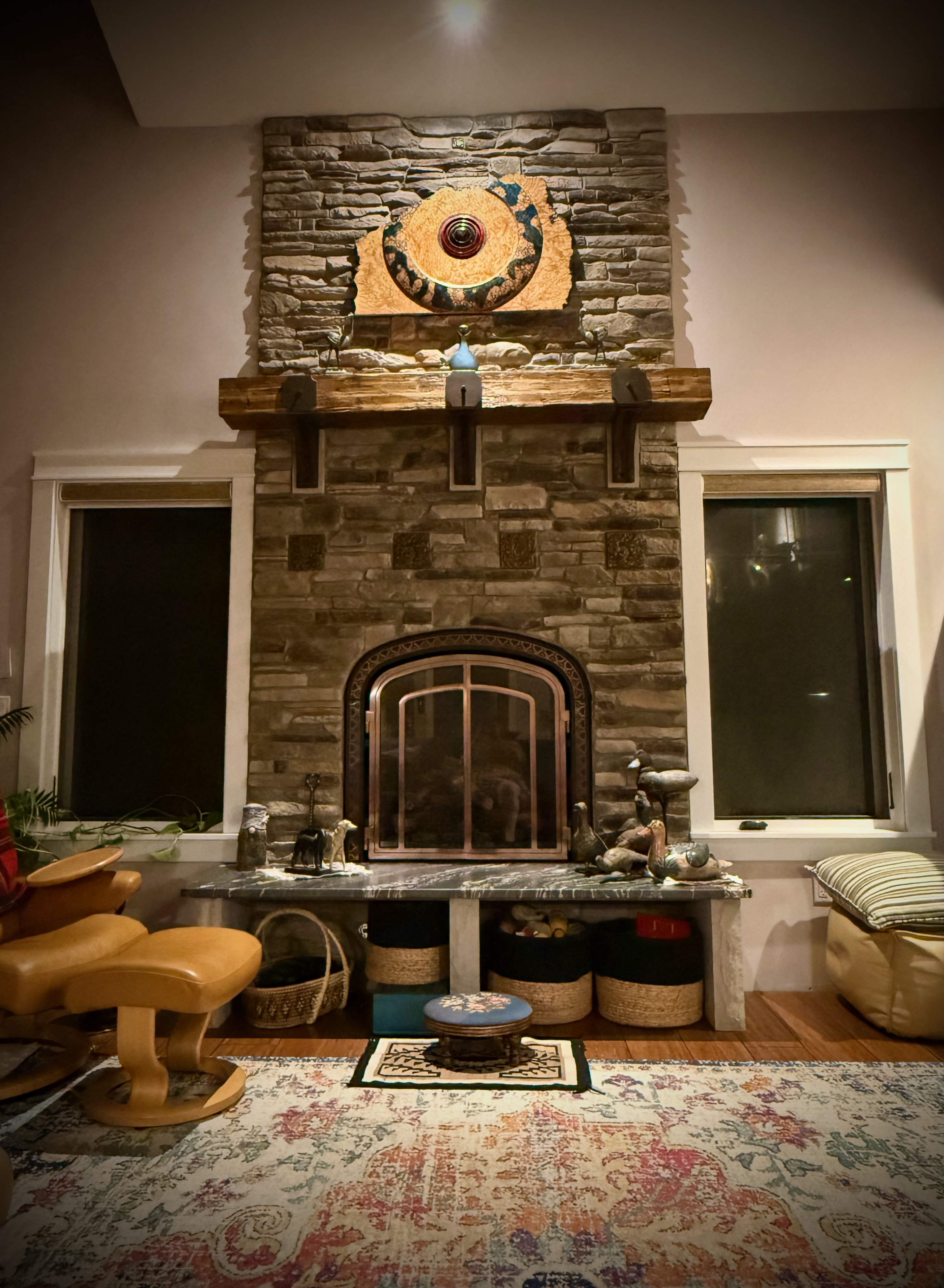
There it was, over 13 feet of stone rising from the floor to the ceiling, a sturdy mantel crossing it about two-thirds of the way up made from a large hand-wrought beam from the old 1840s farmhouse that used to be at this site. Visible signs remained of the making of this beam, from the chips of an adze and ax, to artifacts of its original use with mortise and tenons closed up but left visible, like scars of prior wounds that were necessary to hold the original home together built so long ago.
I can relate to that.
The iron brackets holding it steady to the limestone plinths had another life, too, starting out as bar stools too heavy and dangerous for young grandchildren who would play beside the countertop. Now cut apart and honed into a new life, with forged steel and cut stone, it would serve as support for the mantel.
One light, perfectly placed, made visible the large lathe-turned big leaf maple burl platter, carved, and reimagined as art, reflecting circles upon circles of inner burl knots. With rings upon rings reflecting outer universes to be admired from afar, you become awestruck if you dare to look too long. You won’t be able to look away, for you can’t help but see the spirit within the wood reaching back into your heart. It was the work of my husband Keith, a master woodturner, who left me this treasure, along with a promise not to sell this property.
You won’t be able to look away, for you can’t help but see the spirit within the wood reaching back into your heart.
You won’t be able to look away, for you can’t help but see the spirit within the wood reaching back into your heart.
Sitting on this mantel, now glowing with the light above, against the stone that carries your eyes so high, is a trefoil ceramic vase, three sided and glazed blue with a depth of tiny black speckles, and a silvery copper edging where each side meets. My husband Steven made this piece, along with the iron brackets that support the mantel that it sits upon. He was a master of his crafts, too. And he is also gone. But Steve gave me my next launch to dig deep for an inner strength that I would need to keep moving forward.
I had designed this home. A sketch on a napkin at first. A larger drawing later. It was a vision I’d seen in what seems like a lifetime ago sitting on the hillside with Keith when we first bought this property. Only the old farmhouse is gone now, except for the mantel on the fireplace.
I saw a treehouse view in my head, a house jutting out from the hill. I hoped to share it with my husband. I’d even made a drawing of this very fireplace, watercolors and pens – long before we’d ever broke ground.
I sit here in this room in my home, so hard-won, so many hardships, so much loss. And I acknowledge one truth… that to see the visions come to life and follow them through to completion required a strength of faith I didn’t really know I had within me.
The vision I’d painted on paper was a bittersweet reality now, turned to stone, and metal, and wood and glass. And I can share it with others here among the living. But perhaps not the ones who were either of my spiritual partners, the ones whose love helped stoke my courage to keep moving forward.
Looking up at the scene of the now completed monument to the dreams of my lovers, I wailed and my tears flowed. And then they stopped.
Like most father-daughter relationships, ours was…well… complicated. As I looked at his ashen face, grey stubble covering his unshaven chin, I found it difficult to resolve my own complex feelings about our relationship over the past sixty-plus years. So many conflicting memories flooded my mind.
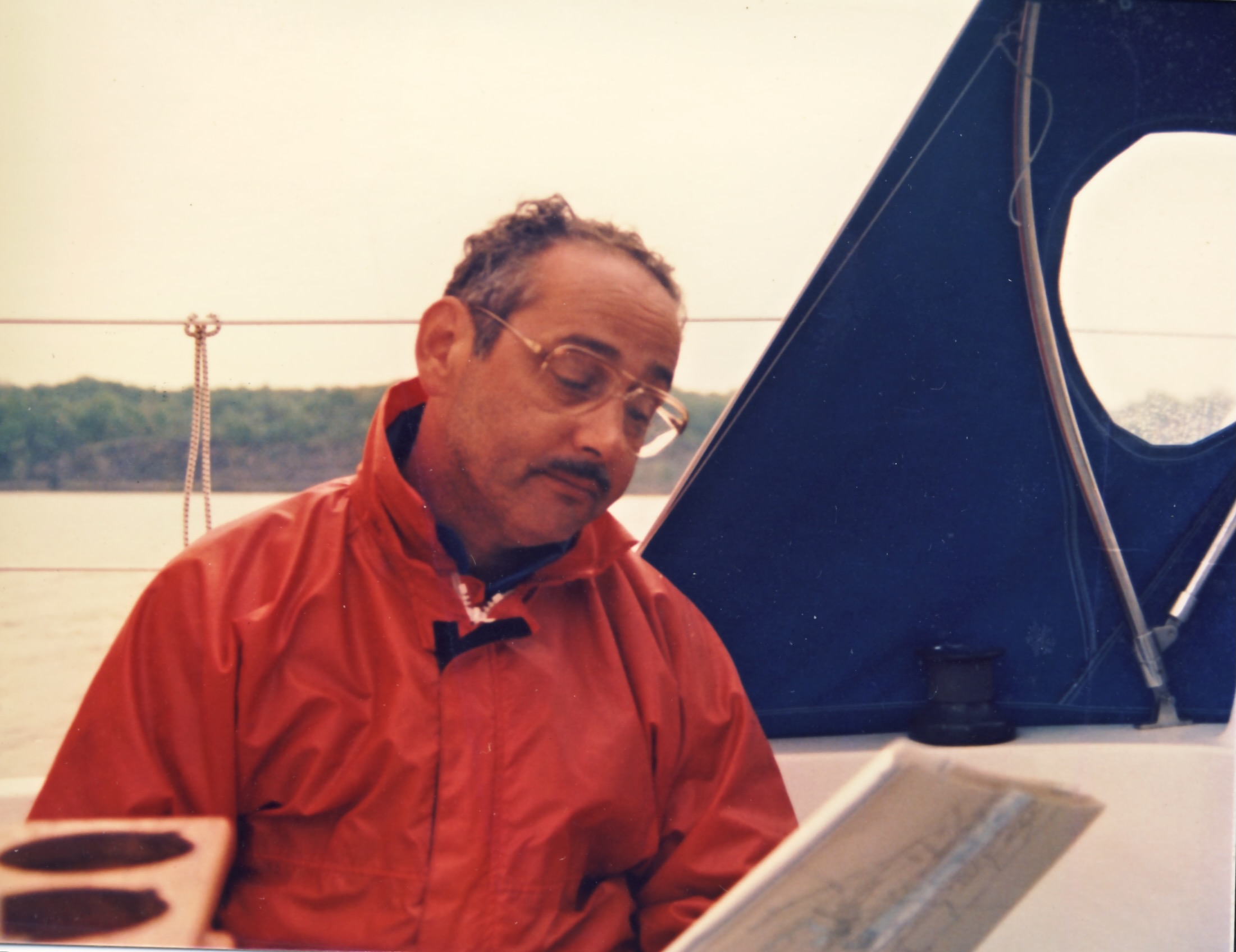
Dad, checking the charts. Photo by author.
Sailing Journeys
My father loved sailing each weekend over the summers when I was a child, and even into my teens. I couldn’t always understand why when I was younger. It seemed to cause a lot of stress for both my parents just to prepare – my mother packing all the food, towels, wine, the chihuahuas, and Dad fussing over bringing this or that for any maintenance or repairs. All of this seemed to exhaust them just to get the car packed. And then there was my brother and I alternately helping and trying to lay low as the rather tense preparations wrapped up before the drive.
Despite the preparations and the seemingly long drive (“Are we there yet?” my brother and I would ask) to get to the Adirondacks, we’d finally arrive at the slip on Lake George where our sailboat was docked, and then have to unload it all into the boat. As I got older, my Dad appointed me as the official quartermaster. He said it was because I knew “how to cram 10 pounds of shit into a 9 pound bag.”
Yet Dad seemed to find his balance on the floating decks of the increasingly larger boats we enjoyed sailing over the years. When I close my eyes now, and try to recall these summer holidays, I can find my father there. Sitting at the helm, tiller in hand, a genuine smile across his face. Then there were the Adirondacks rising behind him as the sun streaked across this 41-mile long glacial lake that cuts through the mountains, our quiet wake making a glimmering ribbon trailing behind us.
And when we camped at one of the many islands that spotted Lake George, we’d meet up with his friend Bernie, and another family, who fancied themselves gourmets. We laughed, we played, and joked about the fact that Mom would bring the silverware that had a three-tined fork, instead of the good stuff. This was a time when peace and joy – mostly – ruled our lives. And for that, I am grateful.
On the Job
Dad also struggled with severe stress from his job, and the balancing act of being an active duty army reservist during the Vietnam War. Working for General Electric, coming straight out of MIT into their training program when I was just an infant, he would tell me how he was excited to have a stable yet growing career as a purchasing agent for this major manufacturer. But I also remember Dad heading off to periodic trainings for the Army reserves throughout the ‘60s. And even as a child, I could see he bore a heavy guilt that weighed on him for being able to stay behind while others of his generation were not so fortunate.
When I was around 7 or 8 yrs old, we moved to Connecticut so we could be closer to his parents since his father had suffered a series of strokes. Yet during that time, working at Perkin Elmer, he was extremely proud of the role he played in the building of the Lunar Module for the first moon walk.
It wasn’t long after those missions, with his job no longer secure, that we moved again, back to upstate New York where Dad took on another position with General Electric, but this time at the Knolls Atomic Power Laboratory. GE was the contractor to design and build nuclear power plants for the Trident submarine and other US Navy ships.
Initially a source of pride, especially being part of the innovative work underway for the Navy, within a few years it had become a source of great stress. Because of the high level of security involved, Dad couldn’t talk about his work at home. One time I remember there was an Open House Family Day when employees could bring their loved ones to see the facilities. Yet I remember that most of it was kept out of sight, behind temporary walls of fabric curtains, and closed doors.
The stress of protestors who chained themselves to the fencing near the security gates he traveled through twice a day just compounded his conflicting feelings, and he eventually broke.
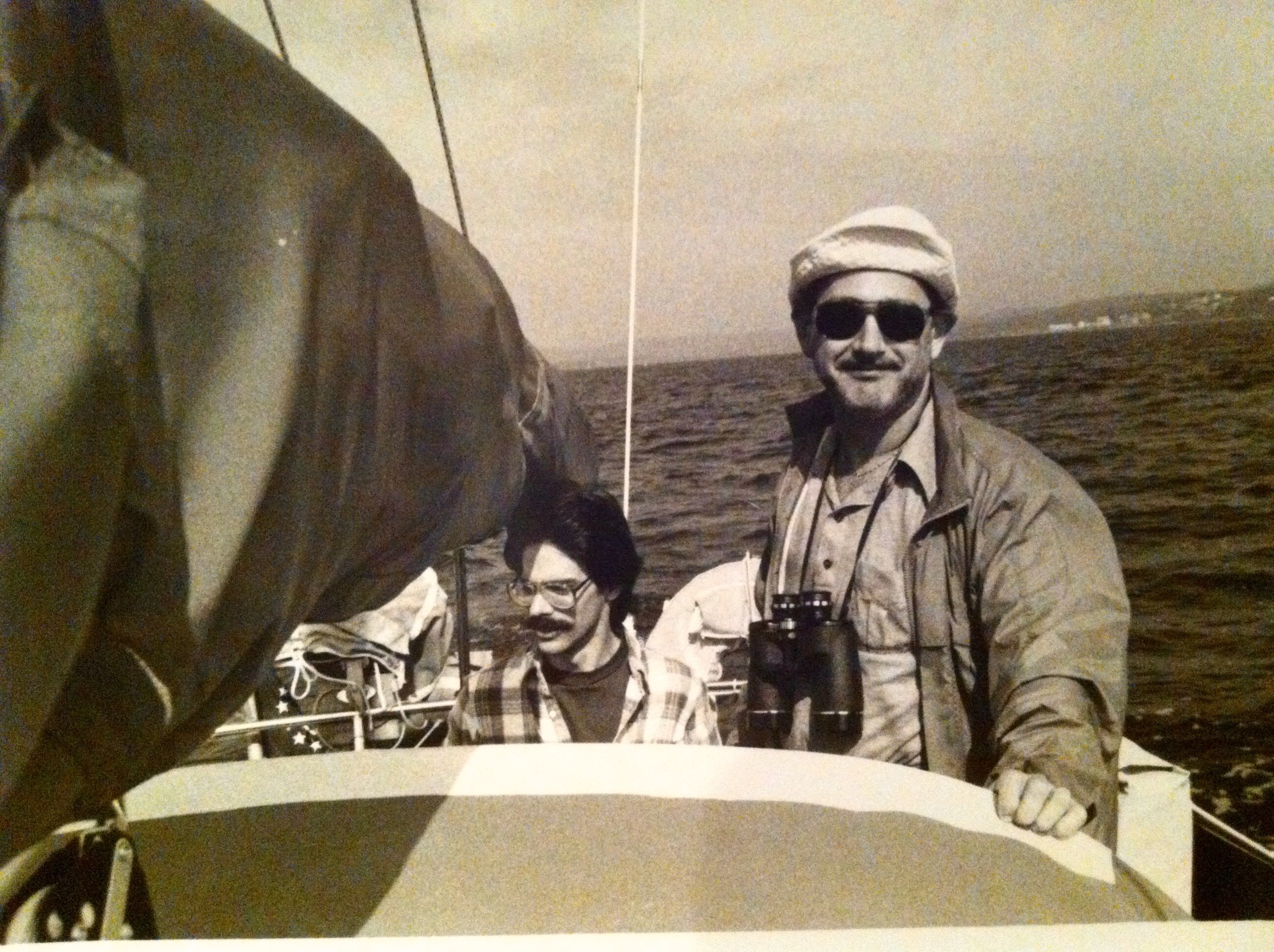
Four years after Keith and I had married, and after moving my maternal grandmother in to live with my parents, Dad announced his retirement at the ripe old age of 47. Their plans included moving to Florida. Mom would take care of moving the house, and Dad would sail his latest boat, a 29 foot cat-ketch they’d named the Talisman, from Albany, New York to Fort Myers, Florida. Keith and I would join Dad and his old friend, Bernie, to sail the first portion as far as the start of the southern Chesapeake Bay. There my brother, and then my mother, would take over.
Keith (left) and Dad, on the Talisman sailing down the Hudson River. Photo by author.
The Chesapeake and a winding path
It didn’t quite work out that way. To this day, I cannot find on a map the particular tributary in the North Chesapeake Bay where Dad had his first meltdown. At least not one that seemed generally as narrow and winding with a small landing and amenities, a river surrounded by, and winding through, grassy marshlands. Now, nearly forty years later, this place lives only in my memory.
Though not an experienced sailor, Keith handled the helm as we motored through the tight turns of the winding river. And more than once Keith mentioned how difficult it was to keep the boat from getting caught in the strong eddies as we zigzagged through the flatland marshes around us.
Finally we could see the landing ahead. And as we grew closer, I recommended to Dad that we should approach it by going against the current rather than with the current which was too strong, and would push us too hard and fast into the dock. But Dad insisted we’d go with the current and took over the helm to manage the landing himself. My job at that point was to leap off the boat at just the right time as we got close enough and then hold the bow line to keep her from going too far. All this while simultaneously keeping the Talisman from scrapping against the edge of the dock.
The current was just too strong. Feeling the rope begin to burn as it slipped my hand, I focused on keeping the boat off the dock. But even all the strength I could muster wasn’t enough. With an aching sound of fiberglass against wood, the Talisman slid hard against the dock along her starboard side leaving a deep scrape down her hull. I tied off the bow, and finally got her to slow down enough to grab the stern line and secure it before she floated out of reach.
The damage was done and yet somehow I managed to avoid the obvious “I told you so’s”. But Dad was pissed… at himself… at the world. Didn’t matter. At some point we all regained composure enough to plan some dinner. With Bernie as the onboard gourmet chef, and the boat well stocked with a bilge filled with cheap but tasty Chilean reds and white wines, he got started.
But as our in-house chef went to refill the fuel into the alcohol stove, the boat rocked, and a bit was spilled in the wells around the burners. So when he went to light the stove, it flared up a bit scaring my Dad who’d caught a glimpse of the flames from the cockpit. Never mind that this was quickly dealt with. Dad was now fuming and screaming at our friend. I knew it was a build up of our earlier mishap since he’d now gotten a good look at the 10 foot scrape on his beautiful boat. But Dad wasn’t willing to apologize and I had had enough.
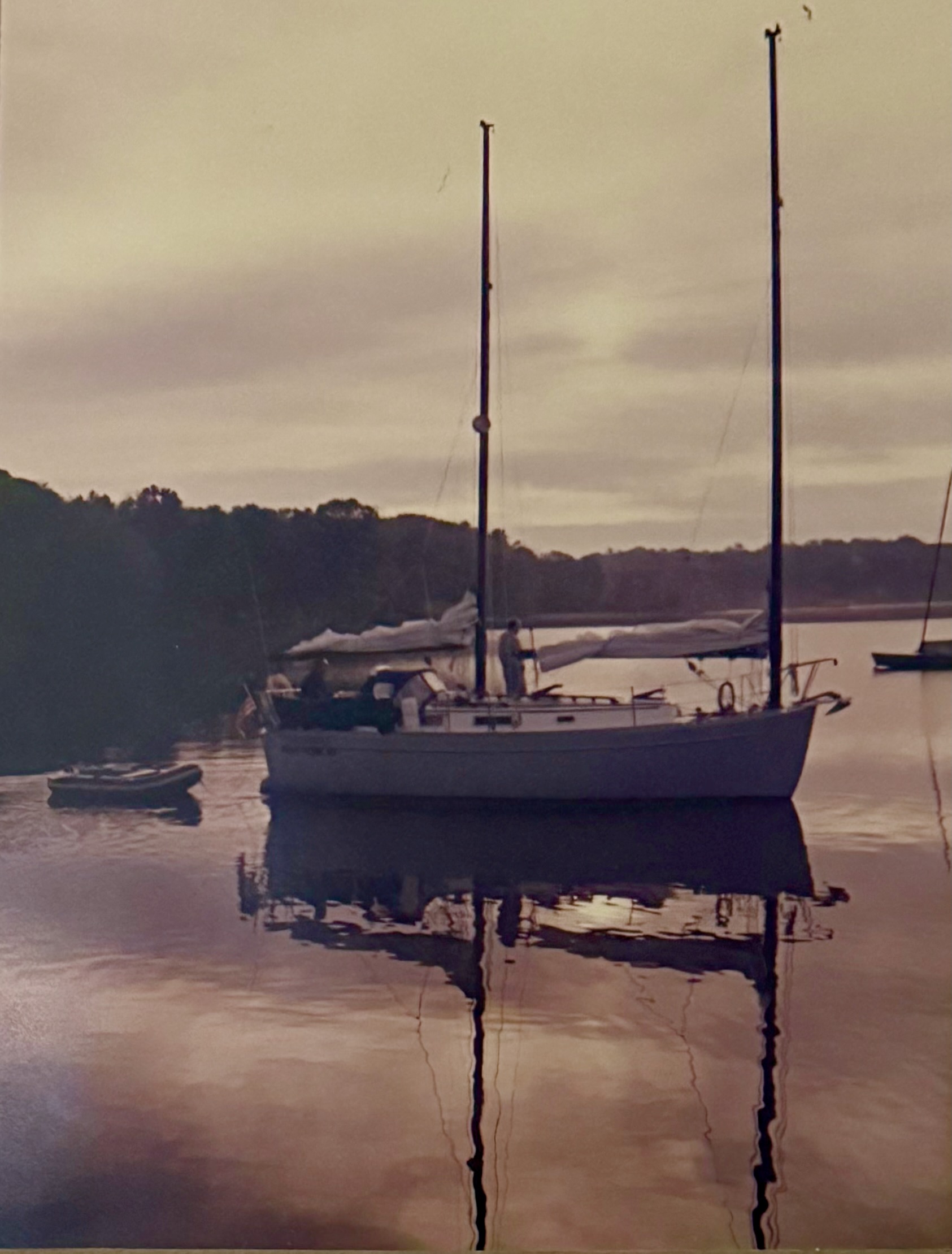
At this point, Keith and I decided to jump off in this middle-of-nowhere spot off the Chesapeake Bay the next morning. At dawn, we stood on the dock waving goodbyes as the Talisman motored away, my Dad at the helm with Bernie on the deck. I took a photo from the dock as they headed off as the early morning sun rose behind them. Later, I would give Dad a framed copy.
The guilt of leaving Mom behind to manage the movers, and the loss of identity with his work, all took a toll on Dad. And, apart from the blow-up he had with me, Keith, and Bernie, and perhaps a few smaller meltdowns along the way after that, the sailing went mostly well.
Once they’d settled in at their destination in Florida, Dad didn’t touch the boat for nearly two years, a depression hung over him that only my mother could finally shake him out of. The photo of him at dawn on the Talisman still hangs on a wall in my home many years later.
The Talisman at dawn, motoring off through a tributary in the northern Chesapeake Bay. c. 1985. Photo by author.
Music – to heal or to harm
Dad was also a man who absolutely loved music. Especially when he and I could play our instruments together. He was a trained concert pianist whose prowess was never quite enough for a soloist, but more than skilled enough for accompanying my mother in her musical performances as a professional singer. And as they built a life around their work in community theatre, Dad would often be involved in musical direction, and lead the small orchestra that would support the musical productions. I still hold dear some fond memories of sitting beside him in the pit as his official page turner on theatre nights.
And when I became rather proficient on the violin, Dad would express his pride warmly, especially when he accompanied me through my increasingly complex and challenging concertos. And I loved those times with him.
But when I tried to reciprocate the exchange by attempting to learn to play his favorite ragtime tunes, one sentence closed me down. I’d been struggling with the syncopated beats that were particularly challenging in ragtime. And I apparently was not doing it very successfully. “If you can’t play it right, then don’t play it at all,” he shouted from the next room.
Dark Memories
With that one sentence, our relationship was cast back to a few years earlier when, as a mouthy 13-yr-old, I thought we’d reached the pinnacle of our tense relationship. Dad’s temper had gotten me a few times, even as young as 5 or 6 years old when I’d caught a fat lip from his large gold class ring from MIT that he wore on his right hand. Ours was a household that included the phrase “Wait til your father gets home!” and the threats of corporeal punishment that implied.
Yet at 13, I had grown either the hubris or courage enough to stand up to my Dad, to not put up with what seemed to me to be an entirely irrational response to whatever small crime I had somehow committed. At nearly 6 ft, my Dad projected strength and power for a guy who usually worked behind a desk. And as I’d slipped to the floor, his left hand held my arm, while his right hand was raised for the swing.
“Go ahead!” I shouted back. “Go ahead if it makes you feel better!” It stopped him cold, and so stopped the argument. We never spoke of it again.
Years later, after they’d settled in Florida, music eventually became Dad’s savior. I remember him excitedly telling me on the phone one day, “I finally am getting paid to do the thing I love!” They’d gotten involved in the local and regional theatre and my parents had been able to rebuild their creative life together again.
An Engagement
While our relationship had generally reached a stasis in my young adult years, and even some tender moments, I still found it ironic when in my senior year in college, I would see Dad stand up for me after I announced my engagement to a man who preferred building cars by hand than engineering them on paper.
When I’d first told Dad about my dating Keith, his first comment was the proverbial advice from a father to a daughter – “You could do better.” But he soon came to care about Keith nearly as much as I did, realizing that he brought a curiosity and intelligence that was less defined by book learning and more by creative analysis and practical hands-on applications.
On a visit to my paternal grandparents’ apartment in Connecticut, I would witness a different side to my Dad. My grandmother, the youngest daughter of Jewish immigrants who still spoke the Yiddish of their Russian shtetl roots, took my news of our engagement with a polite smile. But soon after the announcement, she took me aside into her bedroom for a talk. While my parents sat in the living room with my ailing grandfather, she began her examination. It wasn’t that she was questioning that I wanted to get married. But that my choice of husband to a non-Jewish man, a goyim, was not her preference.
Would I ask him to convert? she asked. No!, I replied with certainty. He didn’t have a strong connection to his own Methodist/Baptist parents’ faith, so why would I ask him to go through the rigorous process of converting to a religion that I held as more of a cultural connection, rather than a religious one?
I left the bedroom conversation as politely as I could – I truly loved my grandmother – and went out to have a quiet conversation with my Dad. I could immediately see a change in his demeanor, something I hadn’t witnessed before. An only child, Dad would almost never say “no” to his mother, a woman who’d spoiled him and doted on him like a little prince.
But when it came to his choice of who to marry, he’d also faced resistance from his parents, which left him deeply bitter on this one point. My mother was considered a poor choice in my grandmother’s eyes. Mom was not raised a “good Jewish woman”, AND had been married previously for a short time and was now divorced, which made my mother “spoiled goods,” unworthy of their special boy. A Jewish divorce was demanded by my grandfather before they’d even consider blessing the marriage. Rabbis were quickly arranged at two ends of a long distance phone call. Three repetitions of “I divorce you”, and the deed was done.
“Harriet! Where have you BEEN all my life?!”
Then there was the argument over whether Mom could bear children because of her hypothyroidism. My grandmother wouldn’t be satisfied until 8-1/2 months after the wedding when my parents handed me – a swaddled baby girl – into dear Sadie’s arms, she pronounced in a loud exclamation – “Harriet! Where have you BEEN all my life?!”
So it was the reminder of how much drama his parents had put them through when he announced his engagement to my mother that ignited my Dad’s defense of my choice.
“You did that to me and Connie,” he shouted at her. “And you’re NOT going to do this to my daughter, too.” I’d never heard my Dad raise his voice to his petite mother. Then he told her, “There’s going to be a wedding with or without you. Join us, or not. The choice is up to you!”
As I watched this exchange with both awe and anxiety, I admit to being very proud of my Dad, and was touched deeply by his defense. And while Dad and Keith didn’t always see eye to eye, as is often the case between one’s husband and the in-laws, we accepted that we came from different backgrounds and it was that blending that made our family stronger.
Time Passages
There have been decades of our lives fully lived since then. And many more stories to tell, perhaps for another day. Keith died of pancreatic cancer, having made it to just past our 30th anniversary, having seen our oldest daughter wed, and our younger daughter graduated from college. He’d enjoyed a fulfilling life, as he himself said. And I, as the grieving widow, deeply missed him.
Then Steve showed up in my life at a time when I was looking only for another adult to talk to. He was kind, helpful, and always had a smile for me when we’d meet. After holding him off from the idea for awhile, his patience finally paid off and we married a couple of years later.
During that time, Steve had only met my parents on FaceTime. But, as the second youngest in a large family, he had demonstrated a deep dedication to his own parents. So it was completely in character for him to offer to help my parents during one of those online conversations with my Mom and Dad.
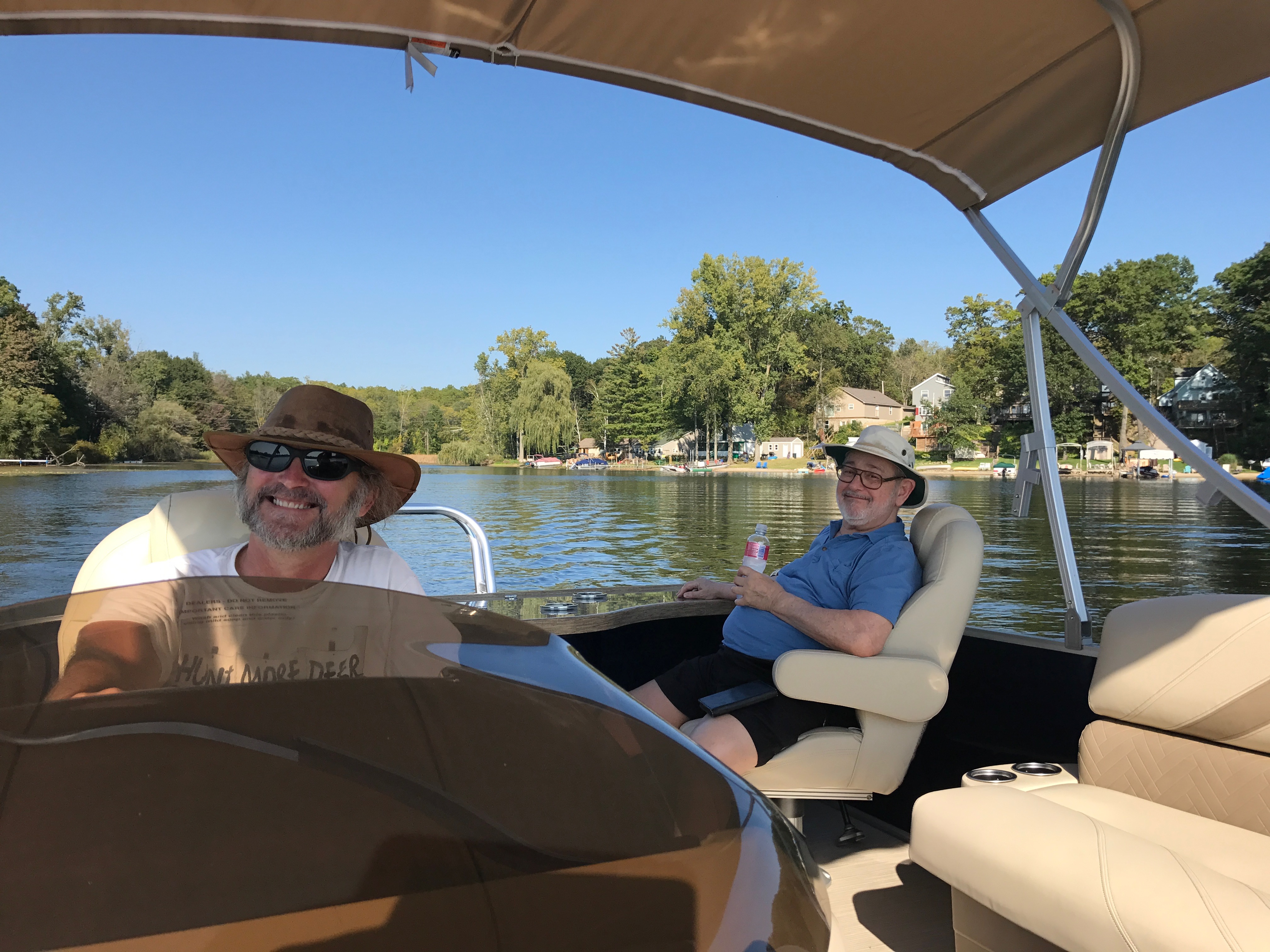
Steve and Dad found joy on the water together when we bought a pontoon boat. Both enjoyed fishing for “little” pan fish on “Big Fish” lake. Steve passed away five years after Dad, and we celebrated his life on the shores of this very lake, a year ago on Father’s Day. Photo by author.
Mom – the urgency of decline
When we’d first started building this home, the design focused on aging in place. A residential elevator provided access to a large lower level apartment which was designed for Dad and Mom, now often in a wheelchair, to live in.
The decision had been made when Dad had been at his breaking point, struggling to be the caregiver for my mother. But caregiving was not Dad’s strength and he was frustrated at the gradual loss of the woman he loved, right before his very eyes. By the time they moved, she had slipped into the full fantasies of Alzheimers, much like her own had mother years before.
Thinking of this now, I feel a deep stab of apprehension over the potential to follow them in this generational pattern of cognitive decline that had been emerging. I wished that, at least in this regard, I would take after my father’s mother, Sadie, who came from a line of long-lived fully functioning elders.
Yet as we built the home, even with the delays caused by construction nightmares, the focus was always on creating a space where my parents, along with Steve and I, would live out our long lives together. Alas, fate had other plans.
Despite the delays, my parents did move in with us, but to my old house, with most of their belongings put in storage while we sorted out the home still under construction, and now caught up in legal battles and remediation efforts.
But the move from Florida to Michigan proved too much for Mom, and she collapsed just a few days after their arrival. When we brought her home from the hospital to pass her last days in peace, I had her favorite music playing to a photo reel of her very creative life and the people she loved. My Dad seemed fully willing to hand over Mom’s care to me and hospice.
During her last days, I invited over several friends from the Jewish community hoping they could provide comfort and sit with Dad who always seemed to find comfort in the rituals. As the older gentlemen chatted and got to know each other, Susie, the wife of one of them, asked if she could meet my mother, though I explained Mom had been mostly unconscious these days.
We entered the dimly lit room and I turned down the music that had been playing. Susie started talking to my mother as if she were awake. I’d previously shared that my mother had been quite the accomplished singer and artist in her day.
“Do you know this song?” Susie asked Mom. And she began to sing to my mother a song from the musical Carousel. “When you walk through a storm hold your head up high…”
As Susie sang the first line of the song, something shifted. And before we knew it, my mother had picked up the song, singing louder in her “on-stage” voice, perfect pitch, and beautifully expressive, though I don’t think she ever opened her eyes.
As the song came to an end, I nudged Susie that it was time to leave. And as we slipped out the door and walked down the steps to rejoin the men in the living room, we could still hear mom’s voice, now singing another song we couldn’t identify. Once it ended, that was the last thing I heard from my mother. She died the next day.
Moving In
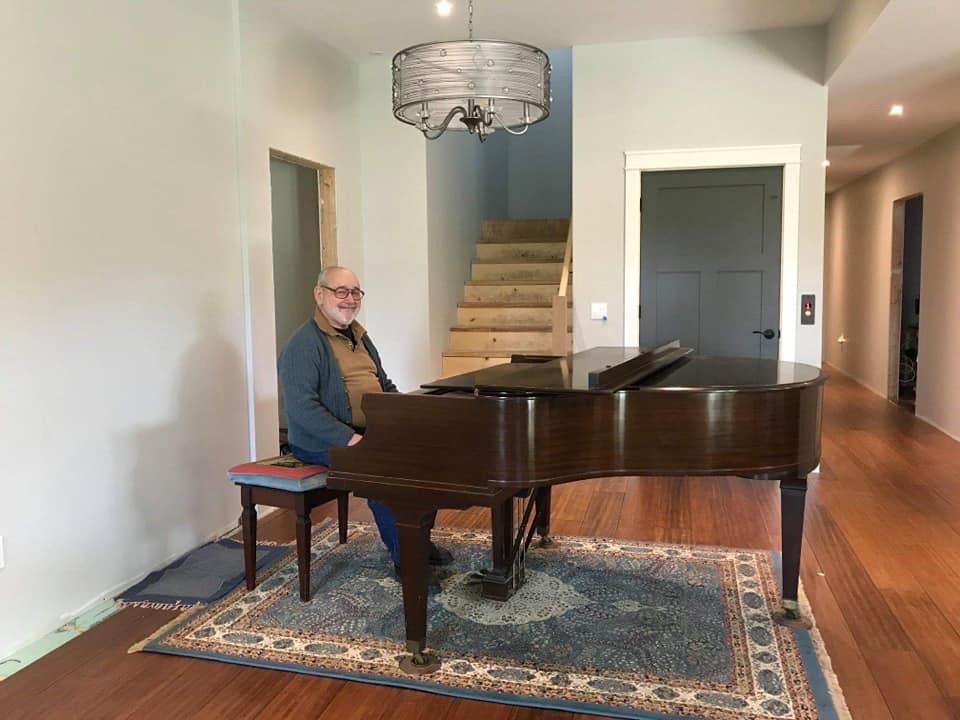
A couple of years later, we finally moved into the new house and Dad was thrilled. I remember the smile on his face when his dear Baldwin baby grand piano was put in place by the movers. It was indeed a momentous day!
Yet there were over 100 unpacked boxes of books that were lined up two deep and three high down the 30 ft long hallway, and another 250 more boxes stacked floor to ceiling in his over-stuffed “office”. These all coexisted with the many pictures he had hung on the walls, and the antiques that were arranged in the spaces that were already crowded with furniture. It seemed that there was still a need for some deep downsizing despite having over 1800 sq. ft. for one man to live in.
“We don’t have room for the New York Metropolitan Museum! We hardly have room for the New York Public Library!”
As I looked at these crowded spaces, with a dozen bookshelves already set up and filled to the brim, there were still so many boxes of books about everything from music, to world and military history, art of all kinds, literature, and religious and spiritual explorations. I was reminded of a playful argument my parents had when I was a child when we’d just moved into our new home in upstate New York. The interchange went something like this: “We don’t have room for the New York Metropolitan Museum! We hardly have room for the New York Public Library!”
Dad on move-in day with his Baldwin Baby Grand Piano that he’s had since he was a child. c. 2018. Photo by author.
Dad – His Final Days
He lay here in the bedroom that Steve and I had created as part of an entire “house under my house”. We’d begun planning this home over five years before. And now, after living here only two years, it looked like we were looking at the end. Dad’s illness, advanced pancreatic cancer, was diagnosed only 5 weeks before, during the week of the Covid shutdown.
I remember that moment. I was working from my home office, the doors hadn’t even been installed yet. But Steve moved them to the top of the list so I could do my job with a bit more privacy while he continued with various house projects.
Dad had just gotten home from his second doctor’s appointment and I’d been unable to join due to the urgent meetings that were happening as we rushed to convert the entire college into an online institution. I was in an interim executive role at the time and was needed to help with planning.
“Dad, how did it go?” I asked before he could walk by my office. “Here. The doc was wondering why you weren’t there, too. But I told him it was due to the college preparing for the Covid shutdown,” he said handing me a CD and a typed report. Reading it, I recognized the lingo. The prognosis was poor.
Me: “Did the doctor explain this to you?”
Dad: “Yeah.”
Me: “Do you understand it?”
Dad: “Sorta.”
Me: “Do you want me to go over it with you?”
Dad: “Not necessary.”
Me: “So what’s your next step?”
Dad: “I’m going to fight it.”
Me: “Okay,” I said, unconvinced.
Five weeks later, as I looked at Dad’s haggard face, I remembered all of this and wondered how we got to this point. How did I end up as Dad’s primary caregiver? How did I end up being the one who would talk him gently through his most undignified experiences, cleaning him up and lightening his most embarrassing moments after his body betrays him? Yet he trusted me for these comforts and assurances. But we both knew the end was near, and so my brother and his family came out to help with Dad’s care.
My introspections were interrupted as I heard Dad asking me a question from his bed. Weakly, pleading. A question I felt completely unprepared for.
“Where do we go when we die?” he asked meekly.
I stood there, quiet, admittedly flabbergasted. I had always assumed that Dad, raised in a conservative Jewish household, would have at least some faith-based concept of the life to come after he leaves this plane.
But surrounded by books that my mother would read while exploring her own wide range of spiritual roots, I stood there processing his question. Finally, I responded, at first with a bit of incredulity.
“Dad, with all of these books filled with explorations of the spirit, did you ever think to read any of them?” I said, slowly waving my arms towards the tall book cases in the bedroom filled with just these subjects.
His answer was a slow turn of the head, and then… “No. Those were Connie’s books.”
So I was left with a new profound responsibility, thoroughly unprepared to share this philosophical investigation with my Dad.
My brother had entered the room and was standing near the foot of the bed. I finally found the words, drawing from everything I learned after losing Keith.
“Dad, it is what you want to believe,” I replied quietly.
“For me,” I went on, “I don’t see it as an ending. I don’t believe in the waste of the energy of the spirit, the soul.”
“And for you, Dad, I know your bond with mom was strong. Find comfort in that, and the possibility of what you’ll find together…in the next life… whatever that means for you.”
A few days later, as I walked down the stairs to check on him, my sister-in-law came from Dad’s room to tell me something wasn’t right.
As I went in to check on Dad, I heard the rattle of his last breaths. I gently wiped his chin, and within a short time, he was gone.
His last words had been spoken just the night before… “Connie, I’ll see you soon!” He had practically shouted to the skies to assure that she would hear him.
We knew they were together again, at last.
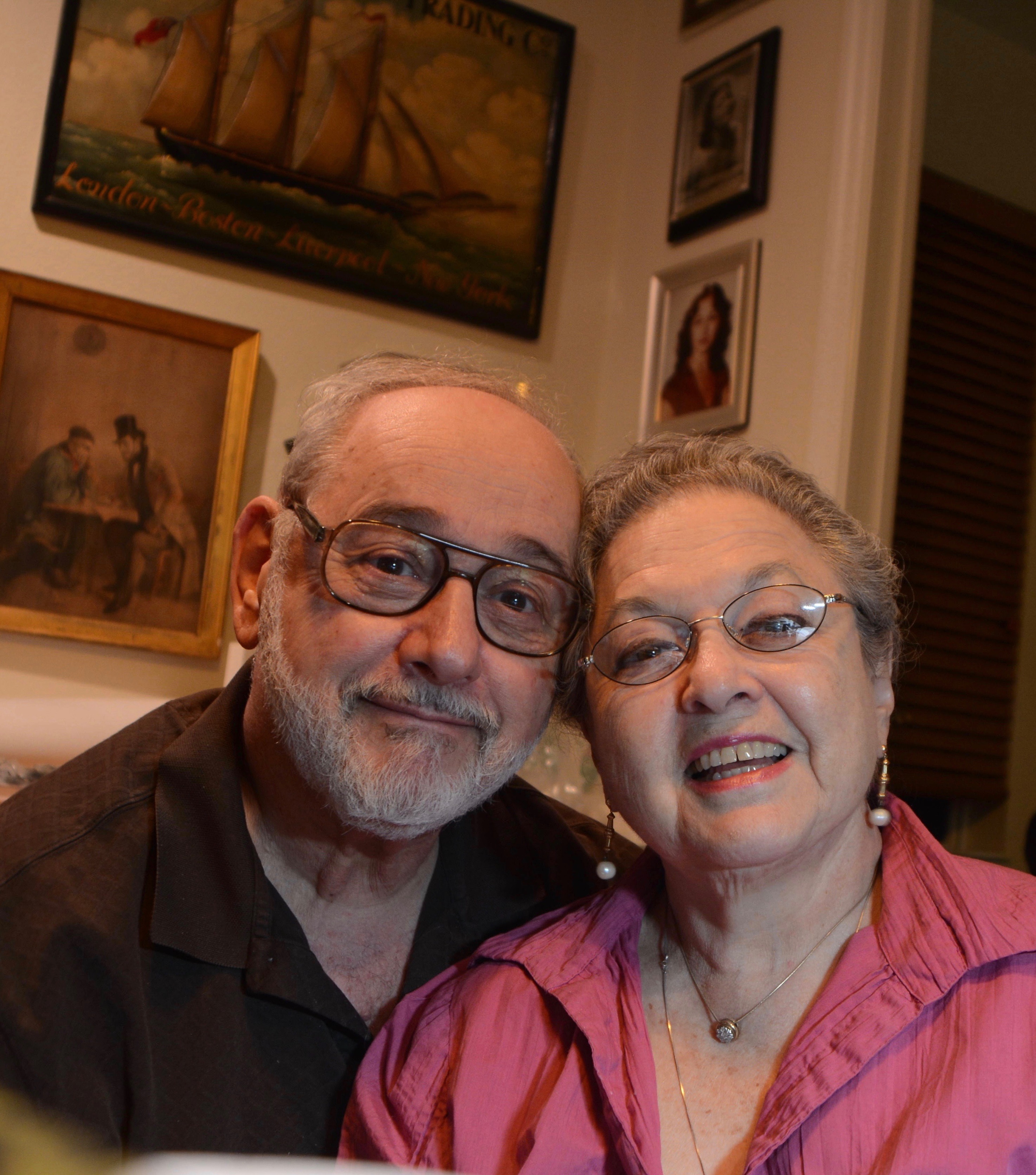
Dad and Mom at their home in Florida in healthier days.
Epilogue
To Dad, I know you have found peace in the great beyond, dancing and singing with Mom. For me, I’ve cast off the old pain, preferring instead to embrace the loving and joyful memories from my youth when roughing it was a three-tined fork. There were more of these memories than I realized.
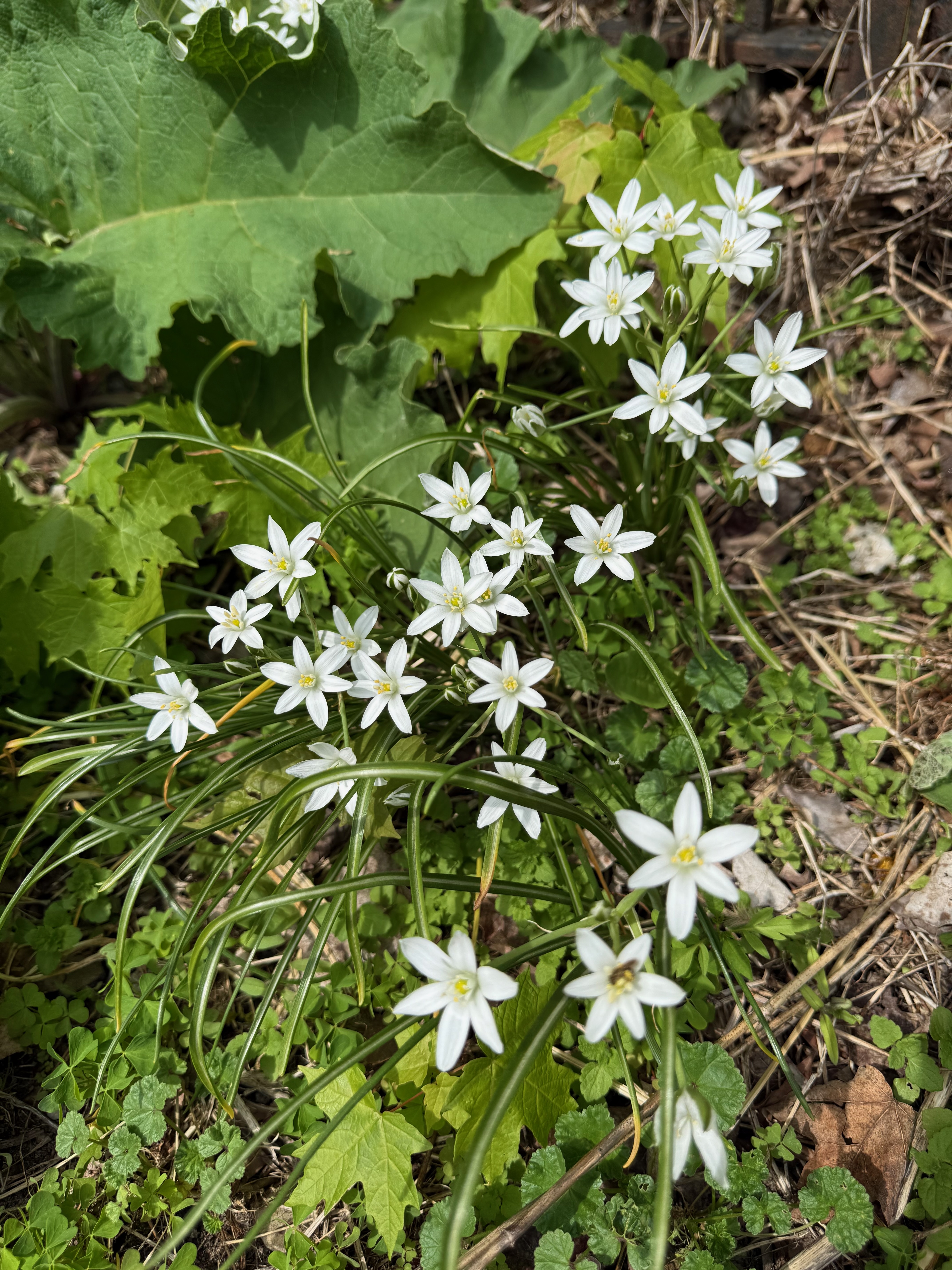
Star of Bethlehem, aka Grass Lillies, growing amidst the rhubarb and weeds in the unkempt vegetable garden, May 2026.
It’s different this time. I’ve been here before. A second-time widow now 14 years older, wiser, more prepared for the storm ahead. I knew I could fall deep into the wake of sadness.
Back when it was my first time, I thought I would die from the pain, so deep, so shattering I couldn’t imagine life going on.
I was in Yekaterinburg, Russia teaching on a Fulbright grant when I first got the news of this diagnosis. Keith hadn’t been getting better, even saying its just a lingering case of bronchitis. He promised me he’d go back to his doctor as he dropped me at the airport and we kissed goodbye.
As studious as I was, I was uneducated in the lingo of cancer, or the many euphemisms it could go by. Sitting in my hotel, and so unnerved by Keith’s ambiguous yet clearly unhopeful words he’d texted to me, I was desperate to reach back out to him.
I found a way to make a phone call over Skype by paying for a phone number. When the call went through, I could hear how surprised he was when he saw the local number but heard me talking to him from over 5000 miles away in the middle of Russia. But I had to hear his voice. I had to make sure I wasn’t overreacting.
I could hear his weakened voice muddied by exhaustion from tests he’d undergone while I had been away, unplanned but supported by my daughters. Metastatic Liver Disease, he said, though I wasn’t sure what he really said until it sunk in minutes later.
“That doesn’t sound good,” I replied.
“Nope”, he reluctantly and quietly agreed.
“Do you want me to come home?”
“Yes,” came the nearly whispered reply.
And at that I knew how serious it was. Usually the midwest stoic, Keith had always pushed through and never asked me for help when it came to his healthcare. But not this time. Now, he needed me and I was on the other side of the world.
Usually the midwest stoic, Keith had always pushed through and never asked mefor help when it came to his healthcare. But not this time. Now, he needed me and I was on the other side of the world.
As I ended the call, quiet “I love you’s” exchanged, I felt trapped. I needed to scream, to cry, to shout. But I feared being seen as the crazy American in this industrial Russian city. I already was pretty much the ONLY Amerikanski here.
I took a different route and had the good sense to go and cry in the shower so few could hear me. But as the water poured over me in the modern white subway-tiled shower, I slid down the wall into a pool of tears and rain shower droplets, trying to cleanse myself of this deep despair.
That was the start of the first time, and the most painful, most despairing experience of my life. The only thing that kept me from ending my own was the knowledge that my own daughters needed their me, their mom. I needed to get home.
Fast forward to the present.
Here I am, now wrapping up a year into my second term as a widow. So many projects left undone. So many questions I would ask Steve as I tried to take my first steps. But the springtime came anyway. And now I stare out at the untended and unplanted vegetable garden patch where we would have tilled and replanted our tomatoes, and beans, and spinach.
Me and Steve, fishing from the shore after we’d sold the boat about a year after he was diagnosed with Stage IV lung cancer, June 2024, Big Fish Lake, Ortonville, Michigan.
It has been hard, for sure. I loved Steve dearly, my second husband, in a different kind of love than my first husband. As an older relationship, we were not hampered with career growth, or raising young children. All adults, Steve brought six children to my two. And they came with their various partners, and growing families. Together, we enjoyed a life we built that was happy, supportive, loving, playing creatively, like two overgrown kids.
When the diagnosis came, Stage IV Lung Cancer, something switched on for me. Survival mode. There were Caregiving tasks that needed to be addressed. Appointments to be made, and people to keep in the loop.
Over the next 2-1/2 years, PTSD from my earlier loss would creep in. But I managed to keep my outward crying to a minimum. We would use whatever time we were gifted to try and continue to live a happy life together, with as much or as little as was required to do that, even if it was just sharing a sweet smile, a loving embrace, and the quiet “I love you’s”.
I realized that what I feared, even more than losing Steve, was also losing this beautiful family he had brought with him. And most directly, losing Sam and his family who had become close to my own older daughter’s family, and who would visit often, despite his long distance. When I shared this with Sam, I was met with a loving reassurance that we’d always be family.
His last few weeks were both physically and emotionally challenging. Ups and downs, exhaustion, tears, laughter, and moments that could be the making of a comedy skit. That is, if it weren’t the end.
His last few weeks were both physically and emotionally challenging. Ups and downs, exhaustion, tears, laughter, and moments that could be the making of a comedy skit. That is, if it weren’t the end. So when Steve died, a sort of numbness took over that was somewhat familiar to me. It served me well enough as I got through the first months after his passing. It is a type of emotional survival mode that would carry me through the worst of it. My caregiving duties were over. Now I could sleep through the night and work on caring for myself.
Between the chaotic weather and my aching back, I’ve given myself permission not to replant the whole vegetable garden. Maybe I’ll just do potted tomatoes and herb plants on the upper deck again this year.
Now, as I looked out at all the various weeds overgrown from my second-story perch, I couldn’t make out what is really there in the untended patch. It just didn’t look like a vegetable garden anymore. On my next walk around at ground level, I made a point to check into the weedy fenced-in patch, ignored and now mocking me with the warming weather after a long cold dark winter.
To my surprise, the already overgrown rhubarb persists even now, despite a decade or more of neglect. It was first planted on other parts of the property by the original 19th Century owners of the property, and has survived constant disruptions of the land over the last 180 years.
And amidst the weeds that filled in the gaps around the rhubarb, starlike white flowers peaked through their thin green leaves that I’d never seen here before. These abundant patches of Star of Bethlehem grass lilies sparkled with hope as the season of new life and purpose unfolds before me.
To make sure I take care of myself in this new chapter, I remind myself to lean in on my toolkit for grief. It is one developed from years of practice living with hope, death and respair, a long forgotten word meant to describe finding fresh hope after despair.
And so, it is is with respair in mind, that I share this toolkit for navigating a journey through grief:
Practice compassion. For yourself, as well as others. You never know if the one you’re speaking to is going through a difficult time, as well.
Breath. Never forget to. When I was learning to scuba dive, the instructor knew that when the beginner diver goes under water – complete with all the breathing gear – their instinct is to hold their breath. We can’t keep holding our breath, even when we may feel like we’re drowning in grief. Just… breath.
Feel all the feels. There is no timeline on grieving. There is no schedule for it. Something triggers a memory – a song, a bird, a word – and the wave overtakes you. And you find yourself in a puddle of tears. Let it out and after the tears, a lightness may take over.
No one can take away your grief. But having a friend or companion who is a good listener can definitely help. And if that’s not doable, for whatever reason, find a compatible therapist, an objective listener trained for just such purposes.
Scream and cry if you must. Do it safely so that you can still wake up to another day.
Read a good book. Even when it makes you cry. Joan Didion’s “Year of Magical Thinking” brought me all the feels. I needed to know I wasn’t alone in these experiences.
Make something new. There’s a certain spark that comes with a new adventure, no matter how small.
Make something familiar. There’s comfort that comes with revisiting the familiar tasks that become your meditation.
Write it down. Share your story in the written word, as much or as little as you need to. Writing it down is like casting it off into the stars.
Take a walk, if you can. Especially in nature. This afternoon, I could admire the Star of Bethlehem grass lilies that found ways to create a sparkling view, even in the midst of my untended and unplanted vegetable garden.
Cry, dance, and sing when the music plays.
Grant yourself grace. Especially on the days when it seems too much.
Practice smiling again. It may feel awkward at times, but eventually it will become natural again.
Give yourself permission. To cry, to love, to be happy…
Talk to him/her. They’re still listening.
And as time passes, be open to the growing possibilities of future happiness in life.
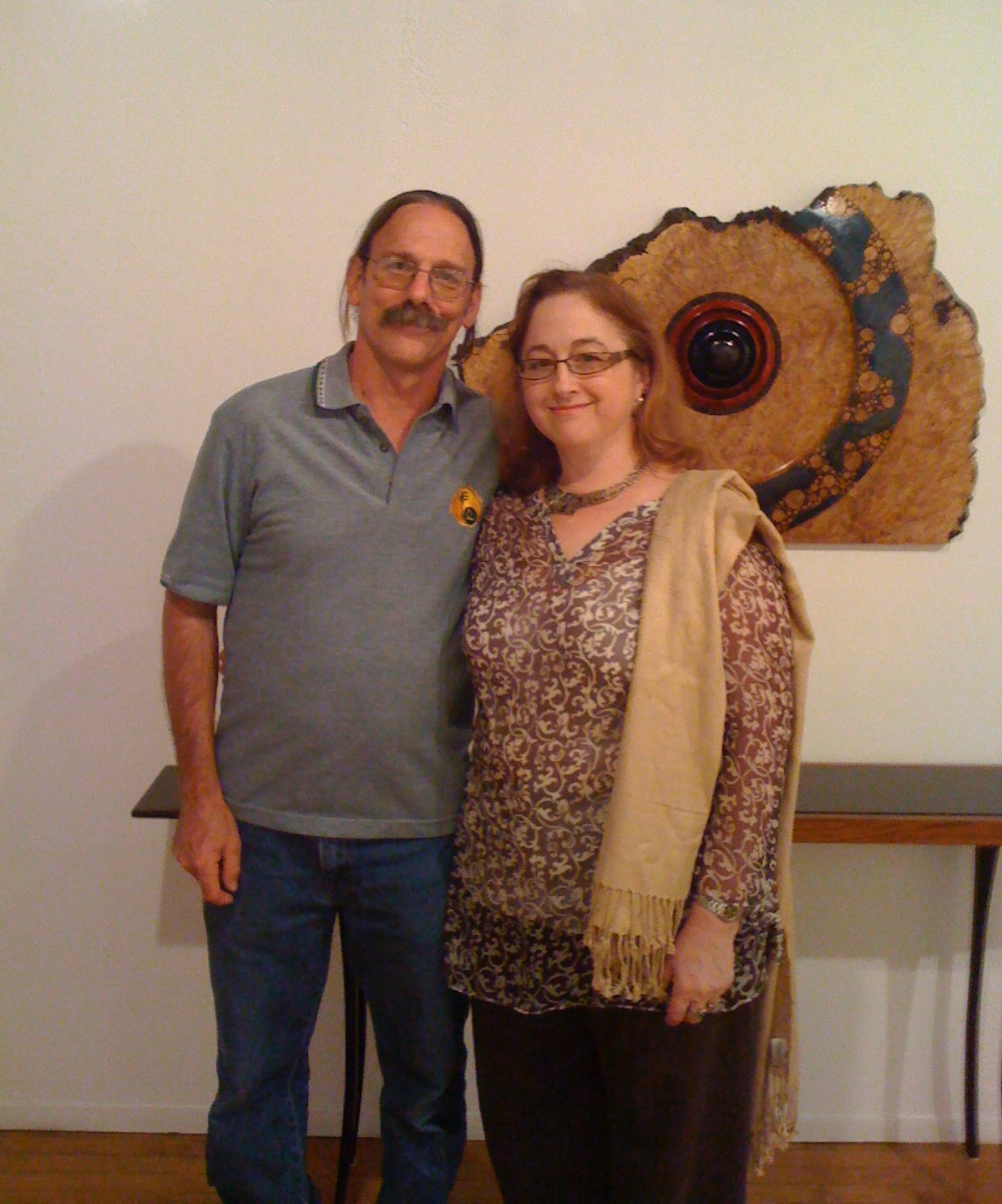
Keith and me at the opening of an art show featuring our work at Buckham Gallery, Flint, Michigan, 2010.
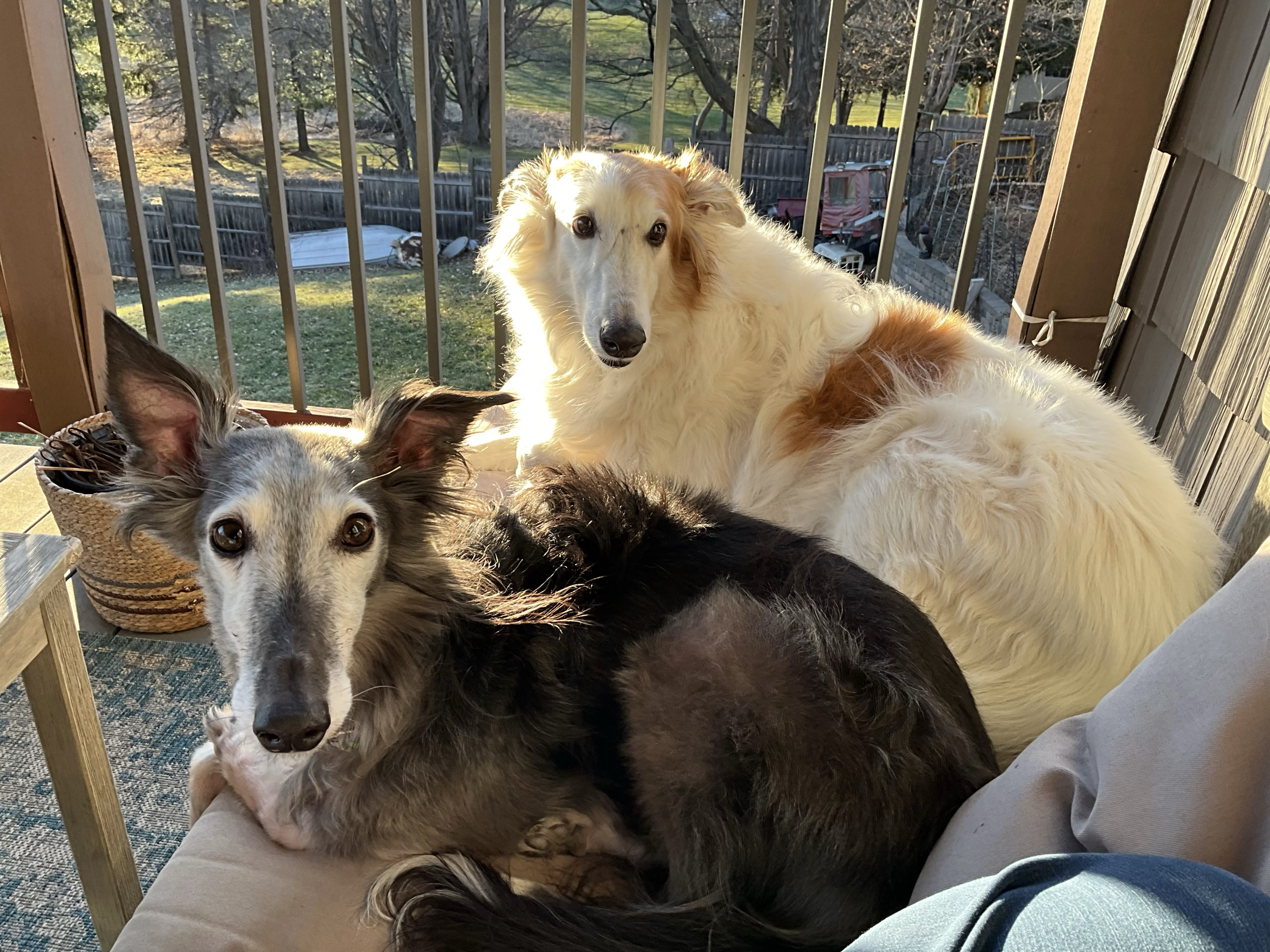
Ralph (left) and Louie, Silken Windhounds, my four-legged guardians. Photo by Mara Jevera Fulmer
We lay on the soft pillows of the chaise, my four-legged guardians and I, perched upon the second-floor porch as the sun was slowly making its way across the horizon, not yet behind the newly budding trees. Their long shadows cast themselves through the flowering pear tree and its maple tree companion, laying themselves across the practically glowing emerald green grass. A chorus of birds filled the air around me.
I took in all of this magic, lost for a time in its spell, mindlessly stroking the soft fur of my pup Ralph, so silky it stirred a memory. I’d always been enamored by Steve’s hair which had that same silky texture, so fine, yet so playfully curly like a baby’s first grown length of hair. So much alike in that same silky way.
I was drawn back to his last hours, as he lay beside me in the bed. I could hear his slow yet shallow breathing, in…….. out…….. in…….. out…….. in…….. out……..
The oxygen generator was tucked away in the next room so as not to disturb us. In the bedroom, his breathing led us in a slow even rhythm, yet barely audible, while the music played softly in the background from the list I’d chosen of his favorite tunes.
in…….. out…….. in…….. out…….. in…….. out……..
It was meditative in the most compelling way, like a swaying of the body that feels like we’re not alone, but part of a greater living breathing being, slow dancing with the rotation of the earth.
In the past I have found myself fully embraced in the harmonic moments of similar slow and gentle rhythms. Such was the case when I found myself floating above a coral bommie in the South Pacific, caught in a flowing dance with schools of fish. All the colors of the rainbow, gently swayed with me in the glimmering of life-giving sunlight beaming down from above, yet spread like angel’s wings around us.
in…….. out…….. in…….. out…….. in…….. out……..
Back in the bedroom, I hear the stutter, the slowing pace of his breath. The time is near and I keep my own breath flowing as I listened for his last one.
in…….……… out………..……..…..
The music ended, too, the last song, “Shake it Up, Baby” by the Beatles…..
I looked over at him to confirm. “You dawg”, I said to his now silent body. A little laugh bubbled up inside at the awesome irony of his departing message.
Yet tonight, the cool air now touches me from the setting sun. Ralph, my silken windhound, provides the silky touch of a memory. I remind myself to smile again.
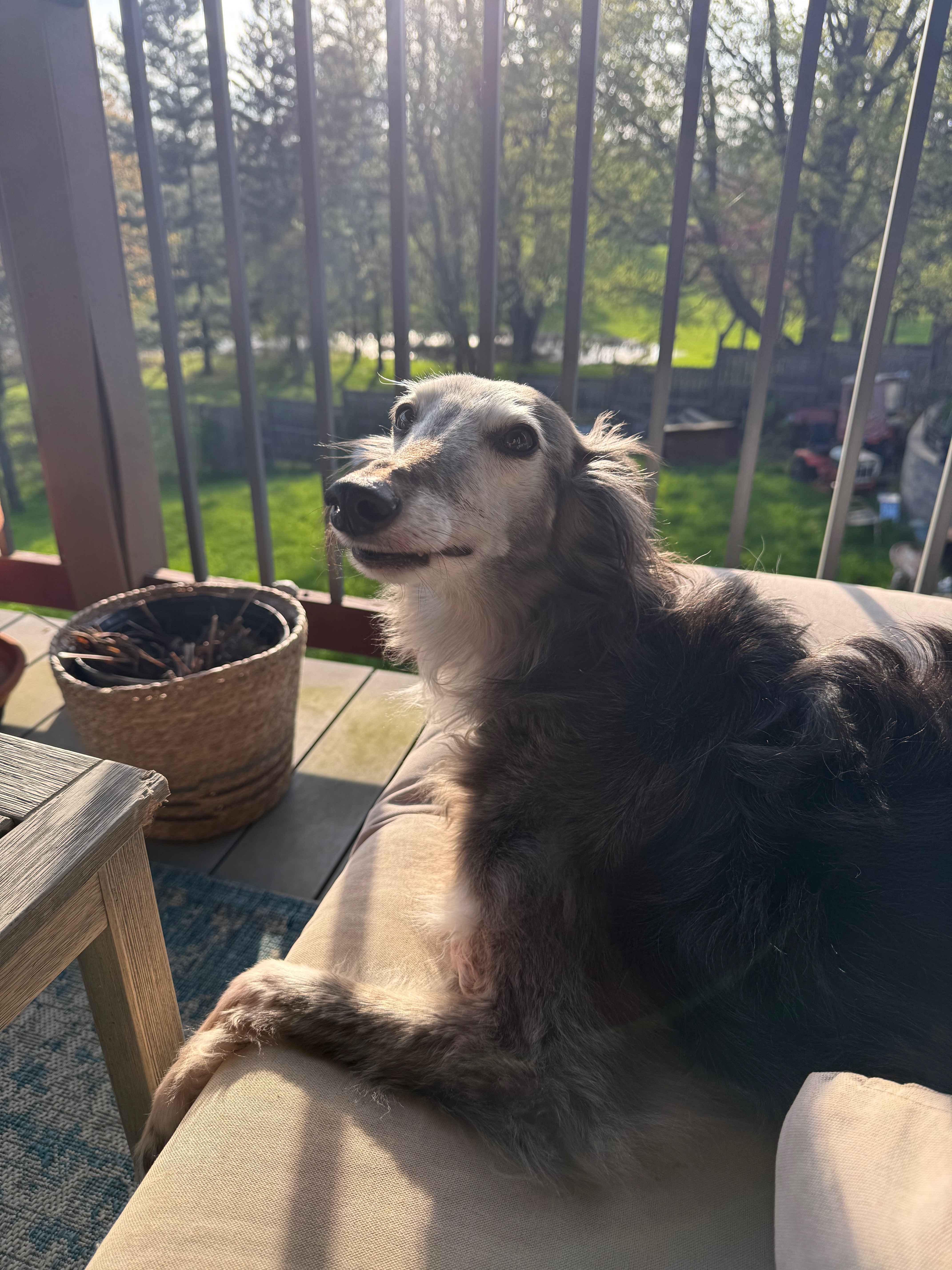
Ralph smiles, and reminds me to, as well. Photo by Mara Jevera Fulmer
This is an icon I created when working in Fiji. It was one of 24 icon-style illustrations with Pacific themes. Being my favorite, I adopted this one as a psuedo-logo.



 Mara Jevera Fulmer's Blog