It’s different this time. I’ve been here before. A second-time widow now 14 years older, wiser, more prepared for the storm ahead. I knew I could fall deep into the wake of sadness.
Back when it was my first time, I thought I would die from the pain, so deep, so shattering I couldn’t imagine life going on.
I was in Yekaterinburg, Russia teaching on a Fulbright grant when I first got the news of this diagnosis. Keith hadn’t been getting better, even saying its just a lingering case of bronchitis. He promised me he’d go back to his doctor as he dropped me at the airport and we kissed goodbye.
As studious as I was, I was uneducated in the lingo of cancer, or the many euphemisms it could go by. Sitting in my hotel, and so unnerved by Keith’s ambiguous yet clearly unhopeful words he’d texted to me, I was desperate to reach back out to him.
I found a way to make a phone call over Skype by paying for a phone number. When the call went through, I could hear how surprised he was when he saw the local number but heard me talking to him from over 5000 miles away in the middle of Russia. But I had to hear his voice. I had to make sure I wasn’t overreacting.
I could hear his weakened voice muddied by exhaustion from tests he’d undergone while I had been away, unplanned but supported by my daughters. Metastatic Liver Disease, he said, though I wasn’t sure what he really said until it sunk in minutes later.
“That doesn’t sound good,” I replied.
“Nope”, he reluctantly and quietly agreed.
“Do you want me to come home?”
“Yes,” came the nearly whispered reply.
And at that I knew how serious it was. Usually the midwest stoic, Keith had always pushed through and never asked me for help when it came to his healthcare. But not this time. Now, he needed me and I was on the other side of the world.
Usually the midwest stoic, Keith had always pushed through and never asked me for help when it came to his healthcare.
But not this time.
Now, he needed me and I was on the other side of the world.
As I ended the call, quiet “I love you’s” exchanged, I felt trapped. I needed to scream, to cry, to shout. But I feared being seen as the crazy American in this industrial Russian city. I already was pretty much the ONLY Amerikanski here.
I took a different route and had the good sense to go and cry in the shower so few could hear me. But as the water poured over me in the modern white subway-tiled shower, I slid down the wall into a pool of tears and rain shower droplets, trying to cleanse myself of this deep despair.
That was the start of the first time, and the most painful, most despairing experience of my life. The only thing that kept me from ending my own was the knowledge that my own daughters needed their me, their mom. I needed to get home.
Fast forward to the present.
Here I am, now wrapping up a year into my second term as a widow. So many projects left undone. So many questions I would ask Steve as I tried to take my first steps. But the springtime came anyway. And now I stare out at the untended and unplanted vegetable garden patch where we would have tilled and replanted our tomatoes, and beans, and spinach.
It has been hard, for sure. I loved Steve dearly, my second husband, in a different kind of love than my first husband. As an older relationship, we were not hampered with career growth, or raising young children. All adults, Steve brought six children to my two. And they came with their various partners, and growing families. Together, we enjoyed a life we built that was happy, supportive, loving, playing creatively, like two overgrown kids.
When the diagnosis came, Stage IV Lung Cancer, something switched on for me. Survival mode. There were Caregiving tasks that needed to be addressed. Appointments to be made, and people to keep in the loop.
Over the next 2-1/2 years, PTSD from my earlier loss would creep in. But I managed to keep my outward crying to a minimum. We would use whatever time we were gifted to try and continue to live a happy life together, with as much or as little as was required to do that, even if it was just sharing a sweet smile, a loving embrace, and the quiet “I love you’s”.
I realized that what I feared, even more than losing Steve, was also losing this beautiful family he had brought with him. And most directly, losing Sam and his family who had become close to my own older daughter’s family, and who would visit often, despite his long distance. When I shared this with Sam, I was met with a loving reassurance that we’d always be family.
His last few weeks were both physically and emotionally challenging. Ups and downs, exhaustion, tears, laughter, and moments that could be the making of a comedy skit. That is, if it weren’t the end.
His last few weeks were both physically and emotionally challenging. Ups and downs, exhaustion, tears, laughter, and moments that could be the making of a comedy skit. That is, if it weren’t the end. So when Steve died, a sort of numbness took over that was somewhat familiar to me. It served me well enough as I got through the first months after his passing. It is a type of emotional survival mode that would carry me through the worst of it. My caregiving duties were over. Now I could sleep through the night and work on caring for myself.
Between the chaotic weather and my aching back, I’ve given myself permission not to replant the whole vegetable garden. Maybe I’ll just do potted tomatoes and herb plants on the upper deck again this year.
Now, as I looked out at all the various weeds overgrown from my second-story perch, I couldn’t make out what is really there in the untended patch. It just didn’t look like a vegetable garden anymore. On my next walk around at ground level, I made a point to check into the weedy fenced-in patch, ignored and now mocking me with the warming weather after a long cold dark winter.
To my surprise, the already overgrown rhubarb persists even now, despite a decade or more of neglect. It was first planted on other parts of the property by the original 19th Century owners of the property, and has survived constant disruptions of the land over the last 180 years.
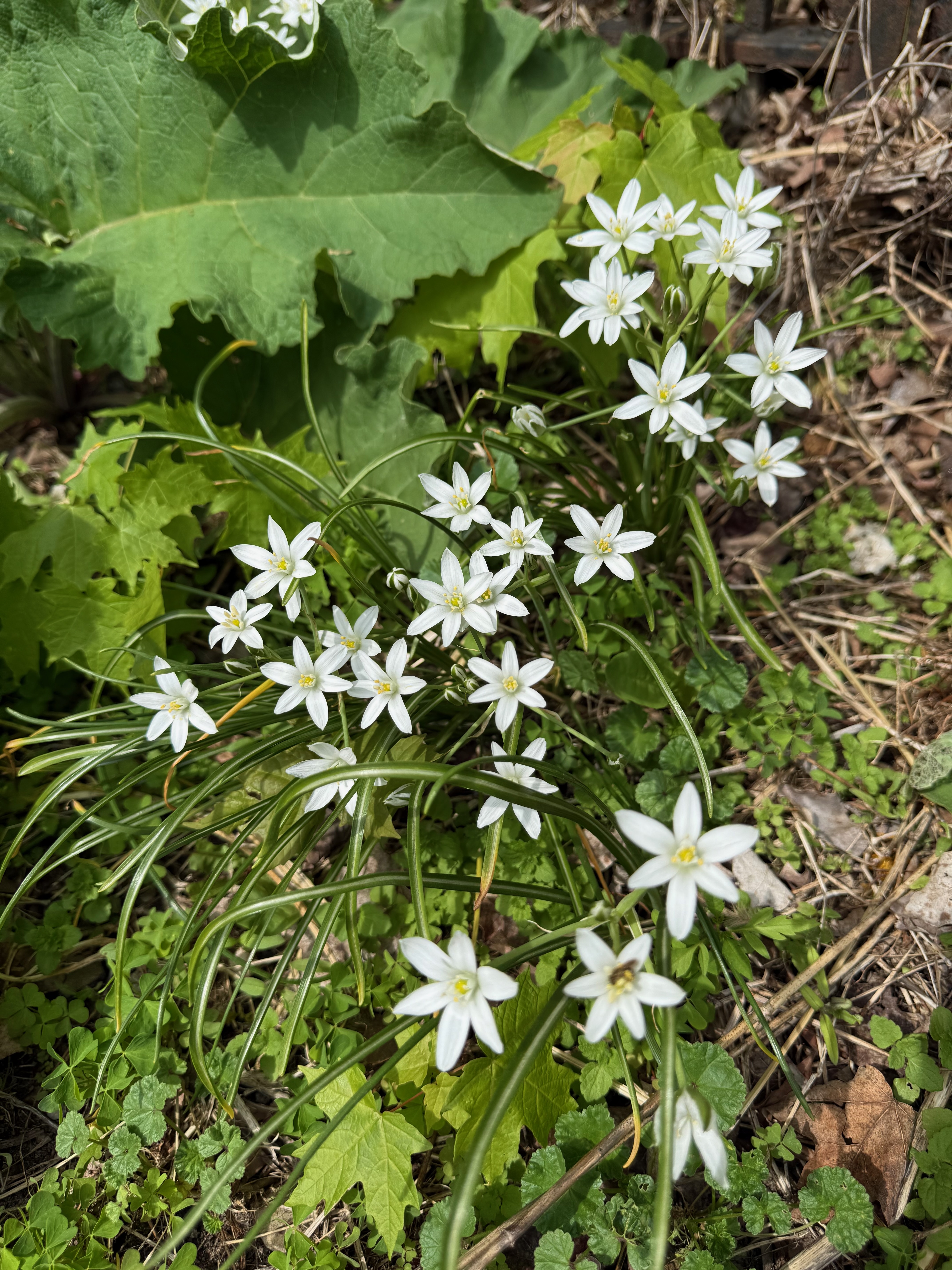
And amidst the weeds that filled in the gaps around the rhubarb, starlike white flowers peaked through their thin green leaves that I’d never seen here before. These abundant patches of Star of Bethlehem grass lilies sparkled with hope as the season of new life and purpose unfolds before me.
To make sure I take care of myself in this new chapter, I remind myself to lean in on my toolkit for grief. It is one developed from years of practice living with hope, death and respair, a long forgotten word meant to describe finding fresh hope after despair.
And so, it is is with respair in mind, that I share this toolkit for navigating a journey through grief:
- Practice compassion. For yourself, as well as others. You never know if the one you’re speaking to is going through a difficult time, as well.
- Breath. Never forget to. When I was learning to scuba dive, the instructor knew that when the beginner diver goes under water – complete with all the breathing gear – their instinct is to hold their breath. We can’t keep holding our breath, even when we may feel like we’re drowning in grief. Just… breath.
- Feel all the feels. There is no timeline on grieving. There is no schedule for it. Something triggers a memory – a song, a bird, a word – and the wave overtakes you. And you find yourself in a puddle of tears. Let it out and after the tears, a lightness may take over.
- No one can take away your grief. But having a friend or companion who is a good listener can definitely help. And if that’s not doable, for whatever reason, find a compatible therapist, an objective listener trained for just such purposes.
- Scream and cry if you must. Do it safely so that you can still wake up to another day.
- Read a good book. Even when it makes you cry. Joan Didion’s “Year of Magical Thinking” brought me all the feels. I needed to know I wasn’t alone in these experiences.
- Make something new. There’s a certain spark that comes with a new adventure, no matter how small.
- Make something familiar. There’s comfort that comes with revisiting the familiar tasks that become your meditation.
- Write it down. Share your story in the written word, as much or as little as you need to. Writing it down is like casting it off into the stars.
- Take a walk, if you can. Especially in nature. This afternoon, I could admire the Star of Bethlehem grass lilies that found ways to create a sparkling view, even in the midst of my untended and unplanted vegetable garden.
- Cry, dance, and sing when the music plays.
- Grant yourself grace. Especially on the days when it seems too much.
- Practice smiling again. It may feel awkward at times, but eventually it will become natural again.
- Give yourself permission. To cry, to love, to be happy…
- Talk to him/her. They’re still listening.
- And as time passes, be open to the growing possibilities of future happiness in life.