Education


20120512-214029.jpg

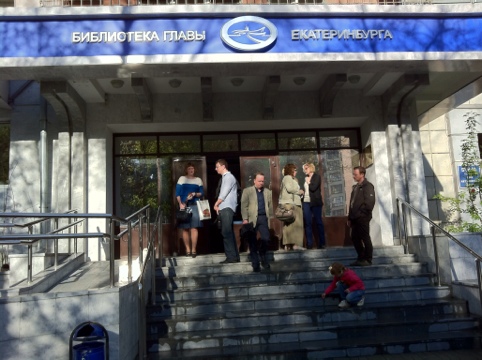
People mill around outside the library after the event and the sun-cleared skies. The American Information Office was a sponsor for the event. Translation issues aside, I hope that the dialogue that we started will continue!

Meeting the Ekaterinburg Public

Having just performed the latest great milestone in terms of my duties here as a Fulbright, I wanted to share some quick impressions since my time is short.

Yesterday evening I gave a public talk at the local library and which was sponsored by the American Information office which is in the same building. Titled: “Rock, Wood, Paper, Pixels: Journalism in the global age of cultural responsibility”, it was more about the role of journalism in promoting cultural understanding and creating an informed public, rather than writing about the arts. This distinction is an issue since in Russia, cultural journalism is seen as purely about coverage of Arts and Entertainment. But, while there is some connection in the American media to this, cultural journalism is also recognized as a deeper sort of writing that goes beyond the isolation of arts coverage and can also provide a more meaningful context for a subject, even (and especially) if the subject is not necessarily rooted in the traditional arts. My focus was on the democratization of media, challenges, benefits and responsibilities of both the author/creator and the consuming public.

The presentation itself was not without its challenges, sometimes humorous, sometimes just frustrating. First, writing it. I found myself dissatisfied with my original direction and its length, especially after coming to understand that a translator would have to interpret everything I said, sentence by sentence. But, after this past week of reading student assignments, watching the news, and talking with my new colleagues, I finally felt I could give this a more complete voice. But I had run out of time after other unrelated issues pulled my attention away. Sleep deprivation didn’t help either. But enough excuses. It came together on time and I felt good about going to the presentation with a reasonable product that could be both sensitive and thought-provoking at the same time.

Heading to the event

I rushed to get dressed now to meet the public, getting down to the hotel lobby a few minutes late. But, then it rained. Not just a light rain. Thunder and lightening, downpours, almost blinding rain. And then there’s me, dressed up for a public talk, hair, makeup, dressy shoes… Just running to and from the car, even with an umbrella held over my head, I was soaked. A trip to the bathroom toilet was only mildly helpful. I’d brought my own roll of TP because I’d noticed it wasn’t common in public bathrooms. But without paper towels or a hand dryer, I just tried to make the best of it. My once dry smoothed hair was now damp, and as curly as ever. A light hair brush didn’t help either. Breath deep, I told myself, and I headed out and back up the stairs to the room.

A bottle of water sat at my designated spot, and as I waited for our hosts to move a large screen television where my presentation would be seen, I opened the bottle…only to be soaked again since it was warm sparkling mineral water. Who knew? I thought to myself as my host desperately tried to find something to dry the table, as I tried to swallow my exasperation by wiping down the cover of my iPad.

We waited a bit until the rain subsided as I chatted with the interpreter and fine tuned a few things on the presentation. Then, suddenly before I realized it, the event had begun, and I realized we were no longer chatting. He was interpreting what the moderator was saying to the entire room. The event was set up as a round table which must have seated 20-25 people and more sat around the walls. Oh dear, I thought. Time to shut up and try and listen to two voices speak at the same time. I had developed the technique of trying to listen carefully to the Russian for familiar words in Russian, or some that sounded similar in English.

As my turn came, I had to overcome my more comfortable style of speaking, and instead I read and then waited. The interpreter had to translate, and I wasn’t always sure when he was done, or if he was just at a loss for the right word. But after awhile, we seemed to find a rhythm. I tried to remind myself to look around. And when I did, I saw many interested faces. As I took a break during the translation, I tried to gauge their reactions, but also to listen to see if I detected anything wrong.

As it turned out, he was oversimplifying what I said, sometimes severely, and thus changing the meanings at times. This proved particularly frustrating for my host who, during the round-table discussion that followed, was actually upset enough to tell the interpreter how his translations were “atrocious”. At one point she tried to help. Instead, we went back to the old pattern and I took some comfort in knowing that at least half the people in the room understood most of what I said in English, without the incompetent interpretation.

If I could use any measure of success, it was this. The talk provoked much discussion and numerous direct questions, the nuances of which were a true challenge for me to understand. Although most of those asking questions were extremely friendly and engaged, at one point a rather arrogant fellow began asking about whether people in the USA would actually want to read “truth” versus “culture”. This was a bad interpretation and I indicated I didn’t understand the question and asked another in return. Later, it became clear that he was asking two separate questions. And “truth” was really “objectivity”, while “culture” was really arts coverage. I think my answer sufficed regardless…saying that although there were some consumers of information were lazy or ignorant of the relative credibility of a source, Americans, in general, craved information of all sorts.

So now the scary part…

Having access to my name in Cyrillic, I decided to Google it to see what had been written about the event. Using Google’s translate function, my heart sank a little bit.

Although I’m not sure how much the bad translations can be blamed on Google, my interpreter, or how the writer further interpreted what they heard, but a few basic facts that were reported would cause credibility issues back home. So I’m here to set the record straight:

1) My MFA in Studio Art/Graphic Design is from Michigan State University, not University of Michigan.

2) I teach Graphic Design and Visual communications, not journalism, at Mott College.

3) Although I have been a writer, designer, and educator for many years, I do not consider myself a “guru”, simply someone who has a passionate interest in the role of arts, media and communications in society.

In the meantime, I enjoyed a lovely dinner afterwards with my extremely gracious host who patiently answered my prodding questions about the event and shared stories of other more or less successful translation events. It was educational to me to hear how my Russian audience expressed their questions about American media and I was curious how well my replies addressed their questions. At one point during dinner, I expressed my sudden horror at the realization during the earlier event that these people in attendance were looking at me as if I could answer for the entire American media culture. Oi vey.

20120512-213346.jpg

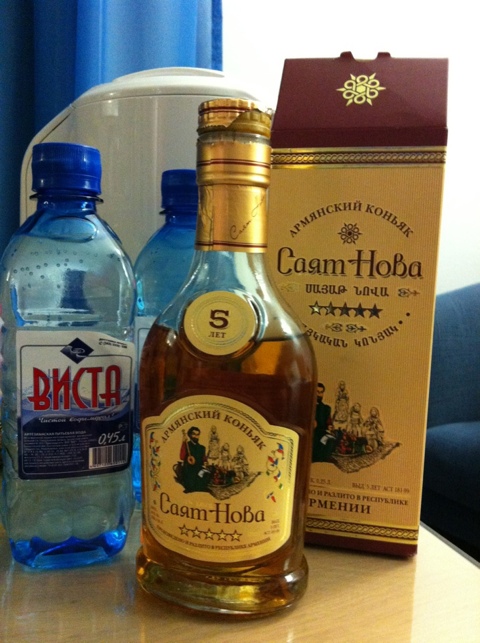
I fed my still rattled nerves with two variety of pismeni (a sort of Russian tortellini) and some blintske with butter and caviar. Later that night, I cracked open the Armenian Cognac I’d picked up at the grocery store and nibbled away at the Obama pie which I’d broken down and bought, mostly out of curiosity rather than any desire for pie. Overall I’d say it was right on… full of promise but with room for improvement. 🙂

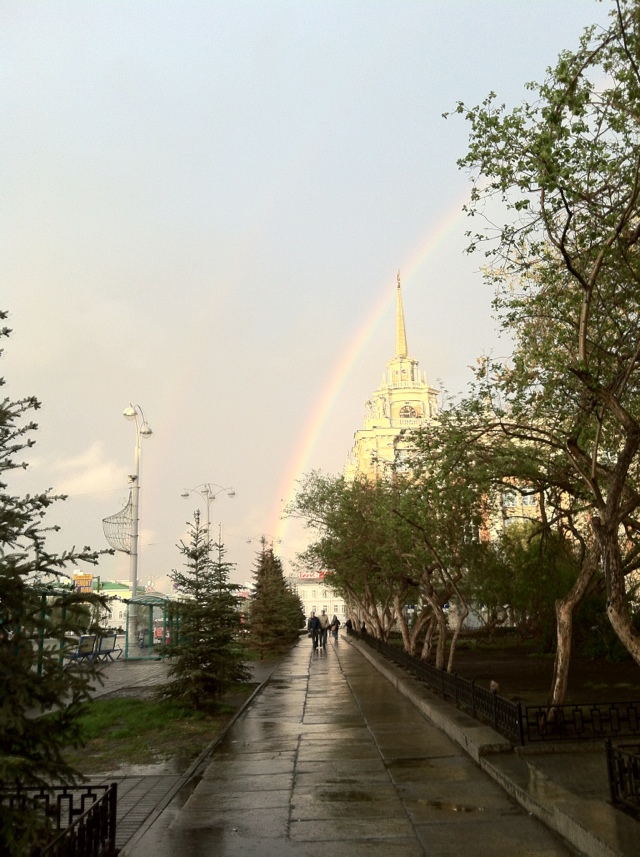
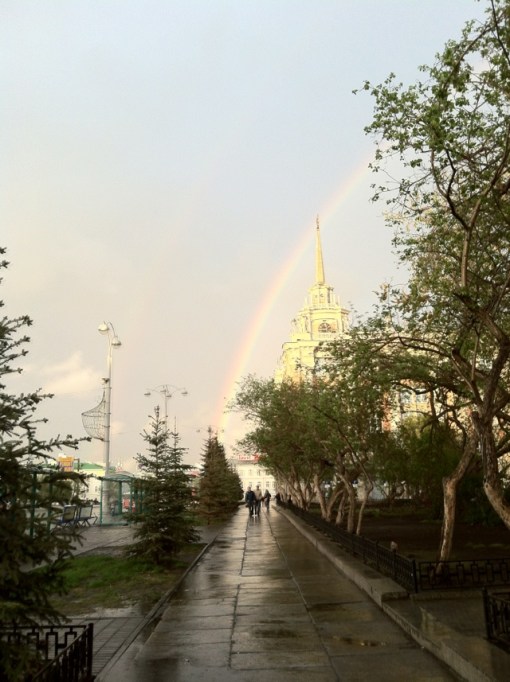
Earlier, on my walk after dinner to the car which was parked a block or two away, the sun hit the clouds just right over the city administration building. Two rainbows appeared and I made my wish figuring it was a good omen. Here’s hoping this is true.
20120512-215405.jpg

::::::::::::::::::::::::::::::::::::::::::::::::::::::::::::::::::::::::::::::::::::::::::::::::::::::::::::::::::::::::::::::::::

Note to my readers: This post is a little out of order. I intend to also write about Victory Day and other activities that have occurred through the week. But I have been kept busy between the cultural activities, grading, teaching (yes… all part of being here!) and some news from home that has lead me to change my extended travel plans, and instead go home earlier. I’ll get back to some of this later in this blog website, or another one entirely if that is deemed more appropriate.

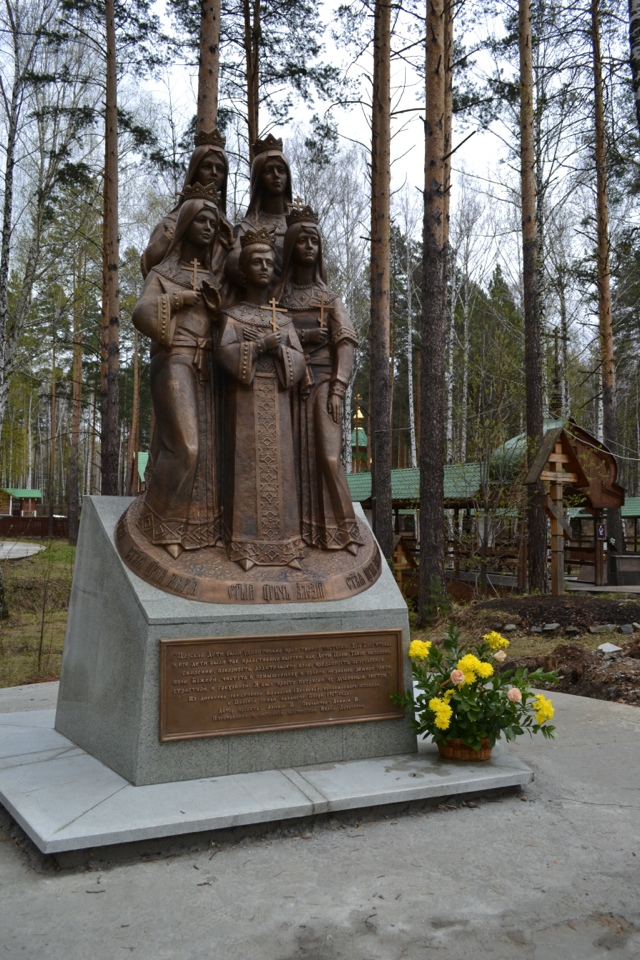
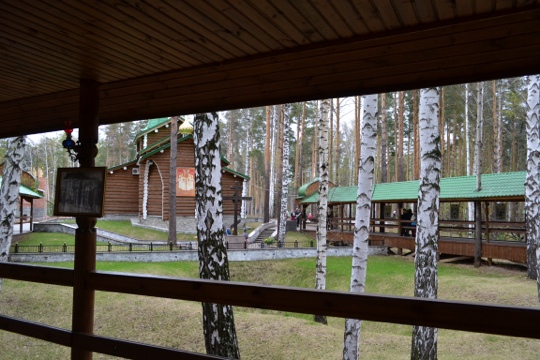
My hosts chose Ganina Yama as my next location to visit. It is a sort of monastery built in commemoration of Czar Nicholas II and his family. The site is the location where bodies were left the murdered czar and family dumped in a mine and supposedly burned there. It is a frightening story with many interesting but gruesome details. But from a purely historical standpoint, it is fascinating. (Read more here.)

20120511-235030.jpg

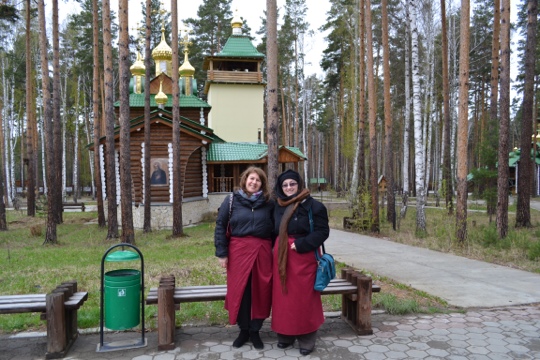
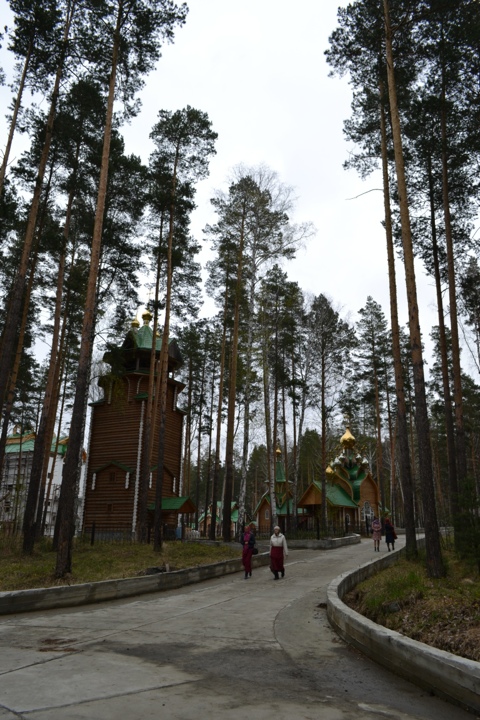
This is a very solemn place and women must wear long skirts and cover their heads walking around, but also especially entering any of the Russian Orthodox chapels. Fortunately, they seem very prepared for overcoming 21st Century fashions, providing long wine red wrap-around skirts for your use. I used my own scarf on my head rather than the ones in their bin by the entry gate.
20120511-235625.jpg
From the photo above, you can see that I look like one of the priests with my scarf over my black hat. But rest assured, there were plenty of devotees led by one of the priests providing details on the canonized family.

You may also have noticed the chapel is built from pine logs in the middle of a large pine forest. A fire recently took down one the primary chapels. However the priests have already started on a nice brick one to replace it.

As I walked around the large complex of buildings among the sacred grounds, there was a special wooden covered boardwalk surrounding a deep depression in the ground. The boardwalk was lined with family photos of Czar Nicholas II and his wife and children. But the pit was at the center, begging one to stare and wonder and how much a single moment in time can change history.

20120512-105251.jpg

I also couldn’t help but think how what happened at this place also changed the course of my own family’s history. That’s something I still try to wrap my head around. Some things are just too elusive in their ability to be brought to such simple terms. Yet I couldn’t help but see that pit as one of history’s pivotal moments.

Russian highways and getting to Ganina Yama

I should have put this part at the start of my story. But it’s idiosyncrasies suggest that a little humor would be a nice way to finish my tale of how we traveled to the monastery.

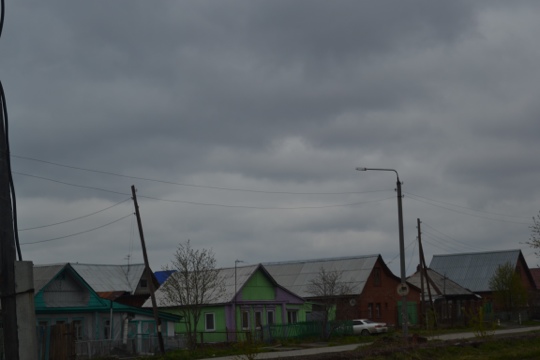
As we drove out of the city of Ekaterinburg, we could see various industrial complexes that immediately surrounded it. Some, I was told, were involved with military industry, while others were more benign. The factories gave way to tall thick pine and birch tree forests, cut in with small villages, dachas, much like the summer camps of northern Michigan. But these were places where many also grew their own fresh vegetables, and I would get a chance to visit a real dacha later in the week for another cultural experience. Some of the dachas are temporary, while others have been made to be more permanent. But, like Michigan, the mud roads would become impassible in Winter. So one must be willing to stay for the long haul if you want to live there.

20120512-110519.jpg

The overcast skies over these dachas promised to make the day even more solemn as they would eventually release a light rain.

Our highway was paved very well, better than most Michigan highways, and a large pipeline followed it the entire way of our travel. My hosts for the day were trying to find a little unmarked side road that would take us to Ganina Yama. But finding none, I could see they were getting a little frantic to find it and stopped several times for directions. We would learn that the little road had been blocked off and one would now have to travel from a regular exit, then through small villages, to get to our destination.

All the while, I am just going with the flow, not worried at all. Why should I? The signs for Ekaterinburg were clearly marked, even for someone like me who couldn’t read Russian. The name has become visible to me, as have some other words, too.

In the meantime, as we wondered the back roads to our destination, Elvis Presley crooned away “I can’t help falling in love with you”… And just as we made our way into the heavily forested and isolated monastery, The Platters reached the closing notes of “Smoke Gets in Your Eyes.”

Yep… Sometimes I really do feel like Alice stepping through the Looking Glass.

20120512-112036.jpg

Monday and Wednesday are holidays this week and the breakfast buffet was closed which meant going to another dining room next door and attempting to order some food. I’ve learned some easy words so far. Kofe is coffee and che is tea. But after that I resort to pointing at the item on the very limited menu which is only a tent sign about 4 inches high sitting on the table which has a few items in English on one side, and the same in Russian on the other. So I point to eggs and, learning from yesterday’s experience, I also point to tomatoes, cheese, and ham, knowing they’ll make this into a sort of omelet. I say sort of because the eggs are just over easy, rather than scrambled. And then the other ingredients are under and over the eggs.

A plate arrives with two rolls, no butter. I decide I don’t need it anyway. The eggs will have enough of that. Coffee arrives… More of an espresso, and I’ve become used to using two sugar cubes from the covered bowl with tongs on the lid, and two creams. It is very strong, but there is a nice reward as one reaches the bottom of the cup and the last sugars not previously dissolved provide a sweetened coffee syrup for the last gulp.

My eggs and juice arrive… No fresh fruit this morning. But this is a filling breakfast and I don’t plan to have lunch today. I’ve done this a few days now since breakfast comes with the room and it is generally very good.

As I make my way through my meal, I read from my iPad a few more lessons in Russian. Although I’m beginning to see patterns, my ability to recall the right words in a speedy fashion is nil. So I resort to Please (pazhalusta) and thank ou (Spasibo) a lot. Manners do matter!

To my surprise, my very attentive waitress arrives with a cup of fruit and yogurt, and another plate with two little honey cakes and something that looks like a small piece of tiramisu. OMG how shall I eat all this?

So… Asking for another cup of kofe, pahzalusta, I try out the yogurt. Good. But a little “grainy”… The best word I can use to describe it. Next, with a bigger cup of kofe arriving, Amerikanska style, I try one of the tiny honey cake muffins. Good… And strangely more satisfying towards the end of the bite… as if the sweetness expands in your mouth. I can eat no more.

All the while, the attentive waitress comes by on occasion to clear an empty plate or, as an aside I found amusing, grabbing a well used paper napkin. Each restaurant I’ve been to has a very purposeful display of folded small single-layer paper napkins. Sometimes, if not just plain white, colors are alternated as the paper napkins folded in triangles are tipped alternately, as well, creating a sort of fan design.

Looking at the little cake, I begin to think “boy that little tiramisu might be nice tonight with a cup of tea.” Checking to see that I was alone in the dining room, I used one of the napkins to lightly wrap the little cake, and then head back to my room to put it in my little fridge for later.

My sleep patterns have been so erratic that I find myself too tired to get up and head out for dinner at a “normal” hour. Yesterday I smartened up a little and, while at lunch at a very fine restaurant known for its pyroghi (stuffed pies), I ordered a slice of a savory pie to go. Based on the recommendation of my host, I tried one filled with sautĂ©ed cabbage. I enjoyed it later last night, but couldn’t finish it for it was almost too rich because of all the butter used. Heating it up wasn’t hard. I use the electric kettle loaned to me by my host and steam the food after the water has boiled and the kettle shut off.

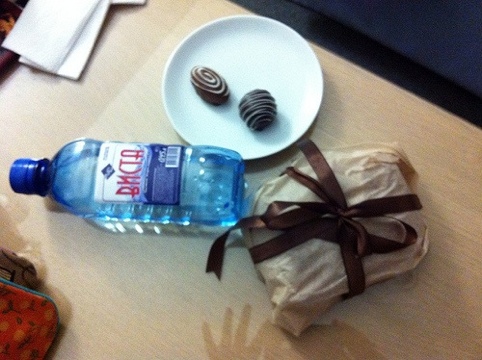
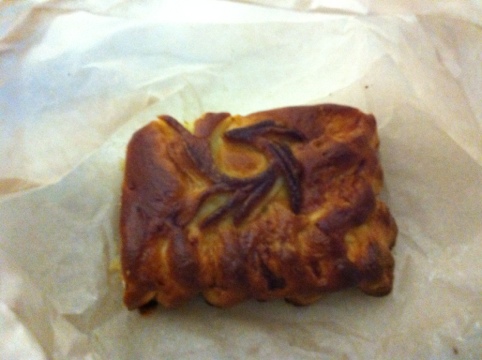
Packaging was special, too, as my pie came wrapped and tied with brown ribbon. The dough was also very decorative making a lovely sculptural design on top.

Because the password for my Internet is constantly changing – and a separate login is needed for my iPhone and iPad – I had to visit the front desk of the hotel last night at 9 pm to pick up new logins. So I decided to check what was at the bar. Empty- it was Sunday night after all – I asked for “room service” to take a bottle of sparkling water back to my room. Some homemade chocolates enticed me so I asked for some of those too, and they were carefully put on a plate for me to take back to my room. I took the requisite paper napkins since my room has only the min. number of towels.

Today, I don’t head out til 2 pm and will visit a monastery. More on that later.

But just as an aside, the daylight has been rapidly expanding here. Sunrise is generally now around 5:50 am and getting a little earlier each day. Sunset is now closer to 10 pm… and it’s only May! No wonder I’m having some trouble getting on the right time zone!

Da svedanya for now!

http://www.flickr.com/photos/50899572@N00/7151417031

20120507-121124.jpg

20120507-121211.jpg

Old building in EkaterinburgChevy AveoSoviet era manufacturing logoView of main city business centerView of rowers on Iset RiverMisc. Graffiti
Street Art BridgeStreet ArtBicyclistsGraffiti artStreet ArtStreet art alley
Street artOld brick buildingOld brick buildingStreet artConstructivist buildingStreet art
Street artStreet art19th C. Ol building19th C. old Brick BuildingBrick entry gateSymbols for "Holiday" provider

More photos from around the city, this group has special attention to street art. Much of it is done with permission, while other pieces are not. The tags are not appreciated. But conceptual works are especially admired. My tour was arranged with my hosts and two students who work as volunteers for a guerilla marketing firm.

One street artist, Tima Radya, does especially planned and admired work, his philosophy studies providing a strong conceptual mindset. The old WWII era hospital was a project that utilized bandages and selective burning of the wood panel surface to create portraits of soldiers from the period. Although he did not have permission to install the work, once he explained its meaning to the caretaker, they allowed it to remain.

20120507-034626.jpg

To see all 100+ photos, just click on one of the thumbnails above to take you to the Flickr set.

Today has been a very full day of tours and conversation. My hosts from EACA have been extremely thoughtful in showing me the elements of the city they feel are important. Not many Western tourists come to Ekaterinburg which was a closed city to the west, especially Americans, until fairly recently. And in spite of the language barriers, my hosts were always considerate to bring along at least one person – a student, staff member or faculty, who could manage translations.

Art from the Urals
The first part of the day was spent at the Fine Arts Museum where I was most interested in art from the region. I will be visiting St. Petersburg later where the international reputation for their art collections is renowned. But this museum contained some very special collections from Ekaterinburg and Russia, in general, that were excellent for someone like me to become at least a little more familiar with art of the region. An interesting note is that it is also in one of the oldest buildings in the city, with a portion of the building dating back to the 18th C.

20120505-213424.jpg

[sidenote here: as I write this Halle Berry is rattling off in a Russian-dubbed version of Cat woman playing on the TV. Good thing I know the plot!]

Chills and Awe

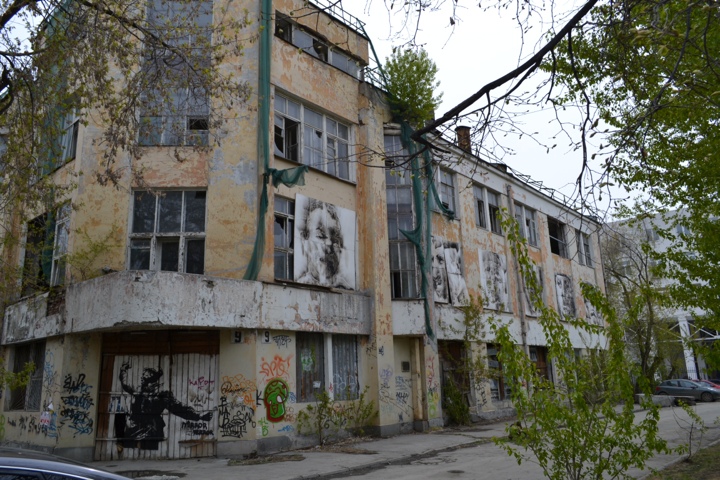
After lunch, my guides changed to another group from the academy who would give me a tour of Constructivist Soviet-era architecture. Ekaterinburg is a gem for its collection of still-standing early and mid-century buildings reflecting the aesthetic of the period. Much of it has been destroyed since Perestroika in other parts of Russia. But my passionate new friends saw this as an affront to an historic period of design. And I can’t help but agree that there is merit in keeping these, at least some of the more definitive examples.

As we walked around, our driver parked not far behind us, the weather challenged even Michigan’s old standby motto (“If you don’t like the weather just wait five minutes.”). At first, it started out cold and rainy, followed by sunshine, followed by a sleet/snow pellet storm, followed by more sunshine, and then another brief appearance of the snow pellets. All in the space of a few hours. The dark clouds would sweep through the region quickly and be gone before you could settle into a nice pot of tea or coffee.

In the meantime, my well-informed guides took me from place to place – Cheka City – a planned community that is going through some stages of redevelopment, and which demonstrates an almost quaint Soviet aesthetic.

20120505-235934.jpg

At one end of the square is a building now used as a hotel, but was a former officers housing, built in the shape of a sickle.

20120506-000316.jpg

But the one building that really created chills and spawned a heartfelt dialogue between my guide, Misha, and myself was a Soviet-era military office building that had additions of neo-classical touches done in a constructivist interpretation. In the center of an open area out front was a sort of memorial display to WWII and the cold war that followed. A small missile, a tank, and a couple of transport vehicles filled the space, while behind them were granite walls that featured round seals with the hammer and sickle.

20120506-000919.jpg

Standing there, I couldn’t help but recall how cold relations had been between our two nations, and how much that the children of my generation had been taught to fear that symbol. Yet standing next to me was a young man, nearly half my age, a product of the post-Perestroika generation, who looked upon this symbol, and the buildings they adorned as simply historical buildings to be admired for their spare aesthetic and an old promise of a new world order. I stood there staring at this symbol behind the military evidence of an era, as we swapped family stories, comparing the histories written by our respective countries and families. I couldn’t help but think that this was why I was supposed to be here… to have this conversation.

The Dance Lesson

Next to this building was another – the Academic Theatre, a name he said meant that it was used for traditional performance work, not that it was associated with any university.

20120506-002219.jpg

We entered this building which still featured much of its original interior, including dramatic paintings featuring Lenin, Trotsky and others. The upper mezzanine level had a beautiful curved hall with classical columns which had been blocked off by benches with a sign that very clearly indicated that there would be dance lessons there. And sure enough,a young couple of probably only about 8-10 years old practiced a tango on the granite floors as their dance master provided stern instruction. When they finished their lesson, we made our way quickly across the space to view a painting of Trotsky on the other stairwell. But as the music began again, this time it was a waltz and the new couple of child dancers made their way gracefully around the dramatic space, their dance master instructing them to respond to the emotion of the music. Remembering the stories my grandmother told of her childhood dance lessons, I admit to choking back a tear as I watched the children dance.

You can watch them, too, and view other photos from this travel journey by visiting the Flickr set I posted here.

Enjoy!

« Previous PageNext Page »