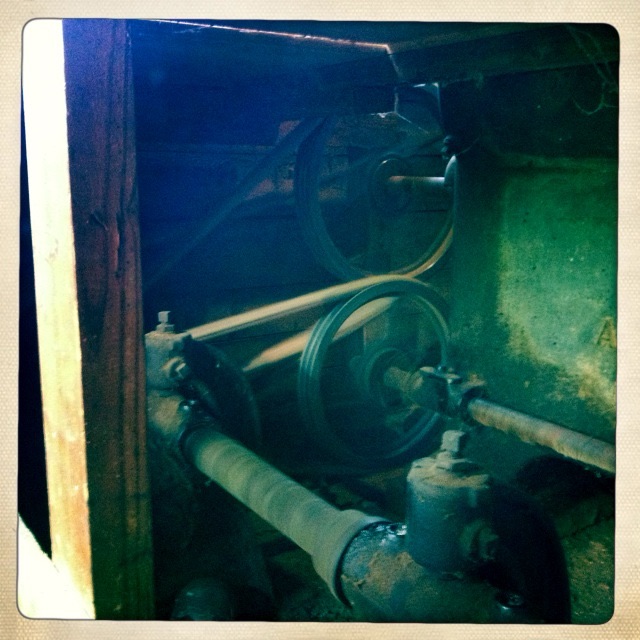
He was bobbing around laughing and smiling, his broad chested yet smallish stature accentuated by the 23,000 lbs of 19th century iron machinery that he was tweaking here and there to coax it back to life. It came from an era when the railroad industry was at its height, three drums of varying sandpaper oscillating to prepare the wood, and a fourth drum covered in brushes to clean it off and ready to use.
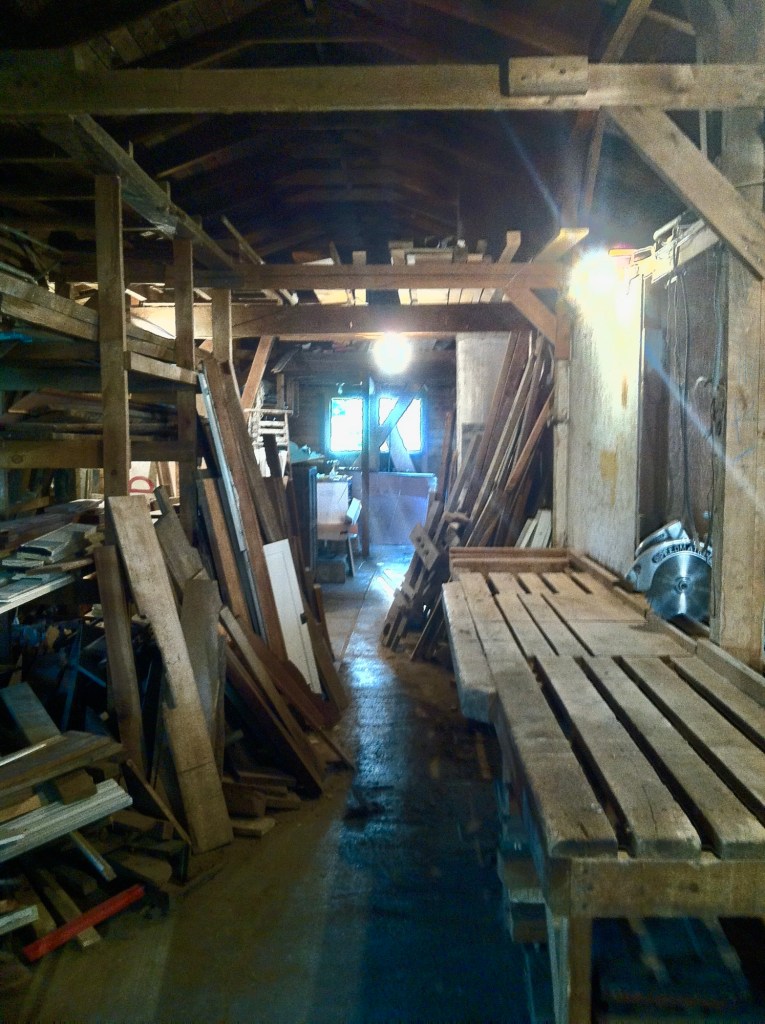
I sat there watching him, though surreptitiously as I was supposed to be doing my homework for my doctoral program. My books and iPad were perched upon the hand-built wooden table saw that the original owner of this post & beam furniture factory had built for himself complete with little victorian flourishes of details in the handles and guards.
But I just couldn’t help trying to keep track of my new beau Steve’s efforts as he climbed up on top of the giant Columbia sanding machine. Then he would hop down again to check the webbing of more large leather belts and their matching steel pulleys that would have made the machine turn its wheels back in the days of steam power.
I remembered when my husband Keith and I first bought this property, not even two years before. We bought it at first sight, a 20th Century post and beam building filled with many pieces of 19th and early 20th century heavy machinery all used to make furniture. An accomplished woodworker himself, Keith had planned to make it all his. Alas, the stars were aligned differently and he passed away from a very aggressive cancer barely a year after we purchased it leaving me, his widow, to sort out what to do with it all.
And then the stars sent Steve. I think KEITH sent Steve, perhaps after being horrified at my poor attempts to try and sell some of the tools I knew I would never use, but that had left me grifted by his own friend. Steve would become my protector. But perhaps in this case it was not that he had fallen in love only with me, I wondered sometimes. It was this place, where it seemed that many ghosts had congregated to protect the legacy of this old maker space.
I looked up and there was Steve, dancing around the machine grinning from ear to ear.
As I tried to go back to my homework on my table-saw desk, I heard the roar and rattle as the beast came to life. Keith had tried to do this before, but the belts were too loose and fell off within seconds. He never had the chance to go back and try again before his illness had progressed too far.
I looked up and there was Steve, dancing around the machine grinning from ear to ear. As I watched this elfish man jump around this iron giant, he went to one end of the machine where large wood panels would come out, fully sanded and brushed off, ready to use for railroad cars. I snapped a picture of him with the light behind him.
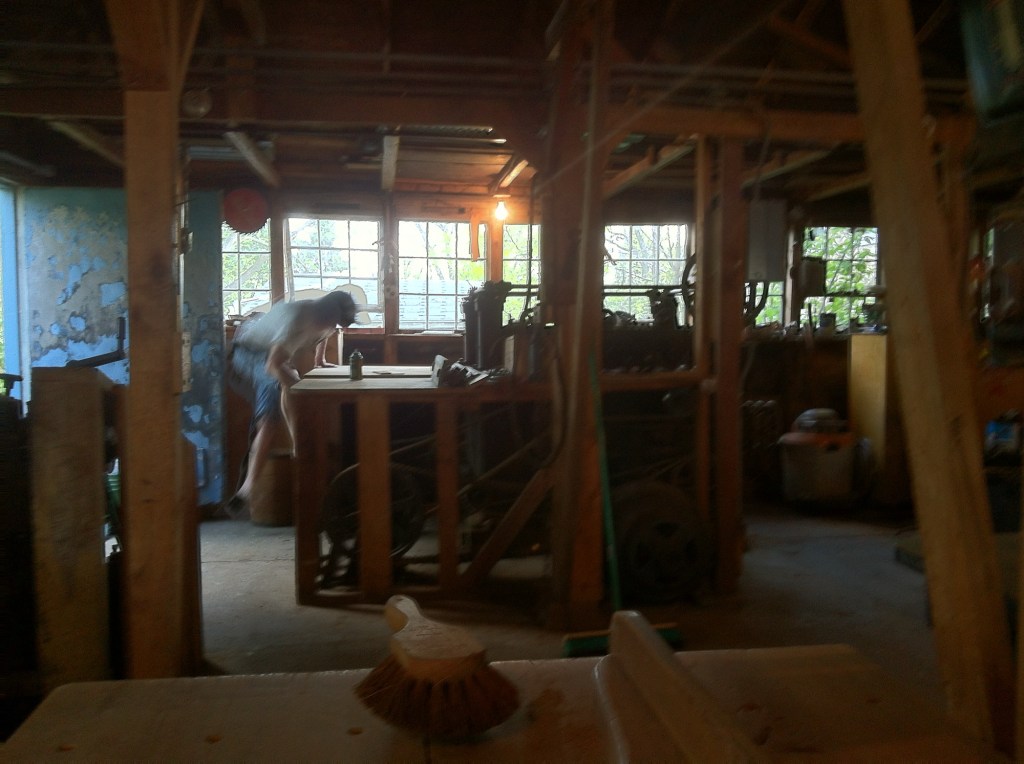
Later that day I would look again at this photo only to catch my breath. There it was, a ghostly shadow of a slim man leaning over just behind Steve. Keith was there, cheering for the success of this rebirth of this giant, perhaps the last operational Columbia belt-driven panel sander left in the country I’d discovered after further research. I took this rebirthing as a sign that I should never take for granted that I am ever alone on this path. And to accept that my angels are never very far from me, despite the temptation to succumb to sadness. That death of my loved one is not an ending. But a new beginning.
– Mara Jevera Fulmer, February 18, 2026
The above prose was expanded from a 13-minute writing exercise during a six-week workshop offered by @LauraLentzWriter and her Literati Academy. The writers participating in this series are exploring their way through grief and the hero’s journey.
 Mara Jevera Fulmer's Blog
Leave a comment